|
History of Alaska Air Carriers
 The following list was taken from the book "Sourdough Sky", a pictorial history of flights and flyers in the Bush Country, by Stephen E. Mills and James W. Phillips (Bonanza Books, 1960). The list concerns a time span of 1923 to 1938.
I would welcome additional information about these carriers (dates, anecdotes, names and places, etc.) and esspecially would welcome photos, thus writing online history on these commercial aviation pioneers. All material will be published with credit to the sender and/or provider.
Other information and photos, such as on early Alaska (or Canadian) carriers not neccessarily in the 1923-1938 time frame, will be welcomed too (including material from privat bush pilots).
As long as it can be classified as "historical" and will add to the understanding of bush flying and commercial aviation in Canada and Alaska before, let's say, GPS was invented. |
| Aho Flying Service | Aircraft Charter Company |
| Alaska Aerial Transport | Alaska Air Transport |
| Alaska Coastal Airlines (below) | Alaska Interior Airline |
| Alaska Inland Airways | Alaska Washington Airways |
| Alaskan Airways | Anchorage Air Transport |
| Bennett-Rodebaugh Company Inc | Bethel Airways |
| Bowman Airways | Bristol Bay Airways |
| Carlson Air Service | Carr Air Service |
| Christensen's Flying Service | Cordova Air Service |
| Dorrance Airways | Ellis Airlines |
| Fairbanks Airplane Company | Ferguson Flying Service |
| Gillam Airways | Graham Airways |
| Gorst Air Transport | Jim Dodson Airways |
| Ketchikan Airways | Lavery Airways |
| Lerdahl Flying Service | Lou Brennan Flying Service |
| Marine Airways | McGhee Airways |
| Mirow Air Service | Nat Browne Air Service |
| Northern Air Transport |
Northern Air Service |
| Northern Airways | Northern Cross Airways |
| Oscar Winchell Flying Service | Pacific Alaska Airways |
| Pacific International Airways | Peck and Rice Airways |
| Petersburg Air Service | Petersen Flying Service |
| Pioneer Airways | Pollack Air Service |
| Reeve Airways | Roust Airways |
| Ruoff Bristol Bay Air Service | Sasseen Airways |
| Service Airways | Star Air Service |
| Walatka Air Service |
Westair Transport (see below) |
| White Pass and Yukon Airways | Wien Airways |
| Woodley Airways (see below) |
Mt McKinley Airfreight( see below) |
Mike Browne wrote me in Aug.2005 with details on Nat Browne Air Services:
"Nat (my father) was the 13th of the first 100 bushpilots in Alaska, initially flying out of Valdez, beginning in 1932/33, then moving to Fairbanks, Anchorage, and settling in Bethel in 1935, and, for awhile, was the first pilot to be based there. He flew a Waco YKS, and later, when he was awarded a mail contract for villages along the lower Kuskokwim & Yukon, and to Goodnews Bay, he had a Bellanca Skyrocket and a Stinson Reliant leased from Alaska Airlines. In 1948, he bought one of the first Cessna 170s with fabric wings. He flew year 'round; floats, skis, wheels.
As for cargo; well, he flew anything that could fit in the airplane, including airsick sled dogs.
Employees: He had native help on the ground, and I think Johnny Walatka may have flown with him for awhile. The pilot I remember best was Ray Miller, now dead, who later flew 737s for Wien in the 1960s, and was first officer on the only airliner in Alaska to be hijacked to Cuba. That was in 1968. The hijacking attempt ended when the airliner landed in Vancouver B.C. to refuel, and the highjacker, a disturbed young man with a .22, surrendered to the Canadian authorities. Ray later told my family: "I tried to talk him out of giving himself up. I'd never seen Cuba." Only a bushpilot would think like that.
In the late 40s, when Ray Petersen was organizing Northern Consolidated, Nat's flying service was supposed to be part of the consortium, but the deal fell through for reasons which were never explained to me. Ray had flown out of Bethel for awhile. In 1950, Nat closed the business in Bethel after being awarded a contract to map DEW line radar sites for the then U.S. Coast & Geodetic Survey, which was working in concert with the Air Force. Nat bought 14 Super Cubs and was initially based on St. Lawrence Island. He later established his headquarters on Lake Hood. The Air Force/C&GS contract was terminated in 1954 when Rick Helicopters of Anchorage stated it could finish the job in less time. This was at the height of the Cold War and speed was of the essence to the goverment."
Thanks Nat!
The Mar/Apr 2005 issue of Airliners (no.92) featured an article about Pacific Northern Airlines
, by Branden Young.
Arthur Woodley started this company (1 man, 1 plane) on 10Apr1932 as
Woodley Airways
In 1934 Woodley Airways was awarded a mailcontract and acquired Travel Air S-6000s to operate between its base Anchorage and Kodiak, Bristol Bay and Kuskokwin. Later on it received the required permit to carry passengers along with the mail.
The war effort brought modern airfields to Alaska and aviation could grow. To attract investors, the company became a partnership on 01Jan44 and was incorporated on 23Aug45 at the end of WW2. With new investors, a new name was chosen: Pacific Northern Airlines (PNA). And Boeing 247D airliners had joined the fleet (they seated 10 passengers).
In 1946 the first of 4 Douglas DC-3D's (N37465, c/n 42955) joined the fleet; it could seat 21 passengers. Later 2 ex-military C-47s would join the fleet as well. On 20Jun46 the Civil Aeronautics Board (CAB) awarded PNA a new route: Achorage - Cordova - Yakutat - Juneau. Since there were no roads linking these cities, this was a vital connection for the territory.
PNA's rivals in the area were: Alaska Airlines, Pan American World Airways and Northwest Airlines. In 1950 PNA was awarded the routes Portland,OR - Seattle,WA - Anchorage,AK. In 1953 Seattle/Tacoma - Juneau followed.
The company needed long range airliners for these routes and bought 3 ex-US Army Air Force (USAAF) C-54s and an ex-Navy R5D-1 (C-54A). The first DC-4 was N3934C, acquired from Aerovias Guest (had previously operated in Mexica, as XA-HOA) and it arrived in July 1951. But when Northwest Airlines operated the Boeing 377 on the long haul routes, the DC-4 came out too slow and PNA needed a faster plane to compete.
Woodley found Delta Airlines disposing of Lockheed L.749A Constellations and 3 were bought: N86524 (c/n 2660), N86523 (c/n 2659) and N86525 (c/n 2662). N86524 arrived on 15Mar55, the 2 others followed in April. They did well on the SEA-ANC route, advertised as the PNA Constellation Flagliner Service with a speed of 300 mph (a cruising speed of 250 mph was more realistic). The 749A's were also assigned to the SEA-Ketchikan (Annette Island)-Juneau route; the Douglas DC-4s flew on the less competitive Juneau-ANC and Juneau-Yakutat-Cordova route.
PNA suffered only 1 accident with loss of life in their history: L.749A N1554V (c/n 2555) crashed on flight 201 from Cordova to Anchorage on 14Jun60; the Connie crashed into Mt.Gilbert, 9 passengers and 5 crew perished.
The competition moved into the jet age and PNA had to follow. Nothwest Orient Airlines introduced the Douglas DC-8 on the Seattle/Tacoma-Anchorage-Tokyo route in 1960. alaska Airlines introduced the Convair CV880 jets in 1961. PNA ordered the Boeing 720 in 1961 and saw delivery in 1962 (N720V c/n 18376 and N720W c/n 18377). The 720 was 02hr45 faster than the Connie on the SEA-ANC route. A 3rd 720 followed in 1966 (N7081, c/n 18042).
But the increased competition forced Arthur Woodley to merge with Western Airlines. The latter had no routes to Alaska and both companies shared a connection point in Seattle,WA.
PNA was absorbed into Western A/L on 01Jul67 as its Alaska Division.
"Just a note, to add Golden North Airways to the list.
In 1947 I was just a kid and had my first airplane ride from Seattle to Fairbanks in a Lavery Airways DC-3, and when we left in 1950 we flew back to Seattle in a Golden North Airways C-46. I think it took all night and I remember a fuel stop in Yakutat."
Ken Price
Woodland, CA
Aviation Safety Network has an accident report on a Curtiss C-46A Commando at Annette Island,Alaska on 22Feb49; tailnbr unknown.
However, www.aerotransport.org specifies one aircraft for the fleet: C-46A N92854 cn250 ex/ USAF 43-47179; but this aircraft is stated to have moved on to Johnson FS.
I would welcome more details, and dates of operation, of this company.
Gilbert Justiss wrote me in Nov.2011:
"I ran across your website while doing a search for information on Golden North Airways. My father flew for this 'non-sched' carrier for a period of time during a period of transition from Northwest Airlines / ATC (1942-1948) to Pacific Northern Airlines / WAL (1954 -1980).
During this period of transition he also flew for MK construction in Alaska, on their LB30's.
I have his log books for his entire career, showing the entries - dates and N numbers of the corresponding aircraft.
With respect to GNA, I have a couple of newspaper articles from Seattle new papers documenting the arrival of GNA flights in Seattle that he flew. One with a shipment of gold from the mines, and on another occasion with two polar bear cubs and their Eskimo caretaker enroute to a zoo back east!
Evidently GNA frequently transported gold shipments south, as Dad several times told of keeping a hand gun in the cockpit as part of security for the shipments...
He also told of on one occasion inadvertently forgetting about a bag of gold on the floor in the cockpit. Seems that they had run into particularly bad weather and strong winds while enroute south, this on top of a late departure. They arrived in Seattle in the middle of the night, several hours late, and extremely tired from the trip. Usually an armored car and two guards met them and took charge of the gold. As they were extremely late, there was no armored car and subsequently dad and the co-pilot forgot about the gold !
After the few passengers they had on board had deplaned, they secured the aircraft and went home. Dad had been in bed for several hours when he got a call from operations wanting to know where the gold was. Dad had to sheepishly admit that, being dog tired, they had forgotten about the gold, and that as far as he knew it was still laying on the floor in the cockpit behind the left seat. Fortunately it still was and all was OK !
For the period recorded as 28Mar1950 to 04Oct1950 Dad only had one aircraft: 'N92854 / Curtiss C-46 C electric props - continually used – 78 trips'. Southern terminus was usually BFI. Crew names Brenner, Evans, Bray, McAuly, Larson, Morrison, Geddis.
He evidently abruptly quit GNA and started with ATA 06Oct50 and flew for them intermittently (again Curtiss C46 Commando's: N5076N, N1300N and N13002N – all Hamilton Standard props) and MK company (Morrison Knutsen construction – DC3 N2075N).
During December of 1950, Jan and half of Feb1951 he flew exclusively for an outfit called New England - again BFI to Alaska, with C-46 N9403H and N1309V, both Hamilton Standard props.
He started full time for Morrison Knutsen 20Feb1951 and flew LB30 68735 until starting with PNA in July of 1951.
He also flew for MK Construction during the construction season of 1949.
After the PNA / WAL merger Dad reverted to flying Captain on the Connies, as he had been flying right seat on PNA's 720's, but did not have the seniority to hold the seat initially after the merger.
He operated the last flight with PNA's Connies for WAL. He subsequently went back to the Boeing 720 and after a few months took his Captain checkride. He continued to fly the 720 / 707 until his retirement on Jan 5, 1980.
He had been elgible for several years to move to the DC-10, but chose not to.
WAL was in the process of retiring the 720 / 707 aircraft and the plane he flew LAX - SEA on his final trip was itself retired upon its return to LAX the following day...
After Dad retired he often said that he felt he had flown during the best period of commercial aviation; and certainly the most enjoyable. I would have to agree. He enjoyed flying in Alaska and the great northwest the most. He spent most of his NWA time in Alaska, and of course with PNA, and bid Alaska schedules with WAL whenever possible."
Gil
|
Ward R. Smith wrote:
My Grandfather, Jack Peck, began by starting an airline called Peck & Rice Airlines in the 1930s, which I believe flew mail, passengers, and cargo in and around the Bethel area.
After this he flew for a time for Alaska Airlines, and then started Alaska Aeronautical (AAI), at the same time operating a Cessna dealership out of Lake Hood. This lasted up until the early 1970s when he sold AAI.
More on Jack Peck can be read on Cordova Airlines.
George D. Hanson shares his memories on early Alaska aviation:
My father and brother both worked for some of Alaska's early airlines.
My father, Virgil Hanson, was an early 'avionics' technician, as was my brother Alan.
Dad was responsible for installing and maintaining some of the early navigation stations in Alaska. He worked for McGee, Star and Alaska Airlines as they progressed from McGee to Alaska. He also worked for Pan Am.
Alan worked for Cordova Airlines, then moved to Northern Consolidated which later became Wien.
We lived across from Merrill Field in Anchorage during WW11 and I can still remember some of it, although I was only 5 years old in 1944.
I worked in plumbing & heating and ran the electric utility in Deadhorse (Prudhoe Bay) from the mid- 1970's to the late- 1980's.
George sent this photo (click on the thumbnail for a larger image)

Josephine "Lila" and Virgil Hanson at Uncle John Urban's place at 3rd & H st. in Anchorage
Virgil Hanson
Unknown & Virgil Hanson
Best regards,
George Hanson in Girdwood,AK |
My father was AK bush pilot from 1934 - 1941. He flew for Alaska Exploration & Mining Co., McGee Airways, founded Bering Sea Airways, then flew for Woodley Airways & Star Air Lines.
We have just published a new book - check out the website www.alaskabushpilot.org (NOT .com BUT .org)
Roy Dickson, Jr.
'Thompson Family' wrote me in Dec.2010:
I saw that your list did not include an airline called Westair Transport. This is a significant airline for several reasons.
It went out of business in the early 1960's. Westair operated from Seattle, Washington from 1951 until it's demise.
In 1961 it hauled more freight than all other air carriers in Alaska, combined. This led to lawsuit headed by Bob Reeve, of Reeve Aluetian Airways. The lawsuit claimed Westair had created unfair competition and jeopardized the well being of government mail carriers, such as his own airline.
Westair was a non scheduled airline that flew both freight and passengers from Alaska, to Hawaii, Seattle and beyond. Their cetificate allowed them to fly anywhere in the world. Westair was operating primarily C-46's (from 4-6 year round), two DC 4's and a C-119 that was the first successful jet pack in Alaska.
PNA, a Cordova Airlines, found the lawsuit frivolous. However, the courts sided with Mr. Reeve and Westair suddenly had to find business elsewhere. They pursued business in Europe and North America but finally had to close their business down due to tax issues.
In 1991, the former president of Westair, Tommy Thompson, received a letter from the state of Alaska informing him that the lawsuit that had kicked him out of Alaska was indeed frivolous. He was given permission to seek damages from the airlines that had perpetrated the lawsuit.
However, at this point in time Mr. Thompson was in his early seventies and felt no fire in him to pursue and restructure a new airline. He did manage, however, to form an air carrier know as Sky Van Airways, after the demise of Westair. It ran off a Part 45 certificate that only allowed freight. This airline functioned in Alaska for about seven years and then was sold to a California business group that dissolved the company in the late 60's.
Westair was known throughout the Alaska scenery. They had the food and supply contract for the DEW LINE (Radar Defense line set up across Alaska for National Defense,) throughout its time in Alaska.
Mr. Reeve, of whom the lawsuit finally forced Westair out of Alaska, owned several C-46's that Westair had sold or leased to him over the years of business competition.
In 1959 Westair received the National Safety award for quality control in the air and on the ground. Westair was on the brink of becoming a major force in the airline industry.
Lynn Burlingame tells a good story about 'Pappy' Reeves:
"My first job out of college in 1971 was fueling aircraft at Anchorage International Airport for Standard Oil. One of our customers was Reeve Aleutian Airways.
Reeve had two Lockheed Electra,s with turbine engines that used jet fuel. Most of our fueling was done with hydrant trucks. These trucks had filters, meters, valves and hoses that connected to hydrant
fittings in pits that were located at the aircraft parking areas.
One morning I went to fuel a Reeve Electra and discovered that it was not parked properly. As a result, the hoses on my truck could not reach the aircraft. This happened about once a week and was a constant source of friction
between the fuelers and the Reeve ground crews.
Since I could not hook up the hydrant truck I had to go back to the bulk plant, load a tanker truck and return to the ramp.
The tanker was an ancient White that was miserable to back. I had to spot it within inches of the aircraft after backing through a maze of compressor trucks, baggage carts, catering trucks and other vehicles.
All of this was done in bad
light with a wet windshield and vibrating mirrors.
If my truck hit the aircraft I would have been fired.
I finally got it spotted and as I got out of the truck Pappy Reeve came boiling up to me...
By then Pappy was in his seventies and looked older. (I never heard him called anything other than Pappy.)
He had an eye patch and was hard of hearing after all of those years sitting behind radial engines. He was a fearsome spectacle.
Pappy owned Reeve Airways, lock stock and barrel - it was a sole proprietorship, and he ran it like he had run his operations all
his life - with an iron fist.
He had noticed that his flight had not departed on time so he came out to determine the cause.
He quickly learned that the delay was because the aircraft had not been fueled, and of course I was the culprit!
Pappy went into attack mode the instant I got out of the truck cab.
First off, he demanded to know why the (expletives deleted) I was backing my (expletives deleted) truck so close to his (expletives deleted) airplane.
Second, he wanted know where I had been and why I had delayed the flight, and -third- he wanted to know why I was not using the 'other truck'?
I got up close to him and replied 'YOU WANT TO KNOW WHY? LET ME SHOW YOU!'
I pointed out the spotting marks on the ramp for the nose gear and the main gear and explained that if the aircraft was not parked in the correct location that the hoses from the 'other truck' would not reach the fueling port on the aircraft and that I had to go back to the plant to load the tanker which is why his flight was late.
I told him that this delayed the
fueling schedule for other flights for the rest of the morning and that other airlines would soon be complaining. I asked if he would mind if I referred their dispatchers to him...
Pappy stared at me for a while and then walked off.
I started fueling and saw him looking at the spotting marks, the hydrant pit and gauging the distances. A few minutes later he came up to me and said, 'It won't happen again!'
It didn't!!
Two years later I was working downtown for the U.S. Customs Service on Fifth Avenue.
Pappy was semi-retired by then and had an office with windows looking out on Sixth Avenue.
One day I bought his biography, Glacier Pilot by Beth Day, at the Book Cache and dropped by Pappy's office and asked him to autograph it. I could tell that he was happy to have the company, and he graciously autographed the book and even drew some sketches in it for me.
I mentioned the fueling incident and he remembered it well.
The inscription reads: 'Flying beats work!! Anchorage, Alaska 11/8/73. To good Great Lander Alaskan Lynn & his fair charmer (?) Glenda Burlingame - with my warm good wishes for an ever sparkling (?) life & all happy landings you can always walk away from! Bob Reeve"
-
Lynn Burlingame

Karl E. Hayes, an avid aviation historian who wrote a monograph on the deHavilland DHC-3 Otter, detailing the individual aircraft histories, wrote me following request in Sep.2012:
"I was very interested in what you have on early Alaskan operators and your page on Cordova Airlines and Alaska Aeronautical Industries, which mentions a Jack Peck. I would welcome more information on Otter N98T, serial 181, which was involved with a Mr Peck.
Your website mentions a Jack Peck who founded Alaska Aeronautical Industries.
In April 1958 Otter N98T was bought by a Mr Vernon J. Peck who had an address in Saratoga, Florida and also an address in Anchorage, Alaska. The Otter was in Alaska. I wonder if this is the same man as Jack Peck? In August 1958 there was great drama when the Otter was flying from Alaska down to Seattle, when the engine failed. Fortunately it was on floats and could land on the water.
It continued on to Seattle and then I have seen a photograph of it in Oakland, California in December 1958 on wheels.
In January 1961 it was registered to Sea Airmotive (Seair) of Anchorage and operated by them until 1974, although it crashed a few times. It was repaired and registered to a Richard V. Peck, and sold by him in March 1977 to Peninsula Airways of Anchorage.
So, this Otter was very much involved with the Peck family, and I wonder if that is the same Jack Peck and his family which founded Alaska Aeronautical Industries and if your correspondents might have any more information on these people, Vernon J. Peck and Richard V. Peck and on this Otter?"
Best wishes from Ireland
Karl
|

Niels Helmoe Larsen sent me in response to this photo:
"MKA is Mt McKinley Air Freight Inc of Anchorage, Alaska; it operated two DC-3s NC49538 and NC74678."
From 'DC-3 The First Seventy Years Vol. 1', page 232.

On 07Sep1946 a C-47 (identity unknown) of Mt. McKinley Airfreight crashed at Nome,AK: weather at Nome was worse then previously reported to the crew. Trying to establish visual contact below 400 feet, the DC-3 drifted from the range shuttle legs and struck fog shrouded mountain. Source: ASN
This may well have killed off the airline too.. See below information:
'FOUR ARE KILLED IN NOME CRASH.
Nome, Alaska, Sept. 9 (UP) -- A blinding fog today was blamed for the death of four persons killed in the crash of a twin-engined cargo plane near here last night.
Officials of the Mt. McKinley Air Freight Co., said the plane smashed into a hillside as it circled the Nome airfield in a ceiling zero fog.
The victims were identified as:
Airline Vice President LEE CHESTERFIELD, Anchorage.
Pilot MARVIN L. PRATT, and his wife, of Bellingham, Wash.
Co-Pilot JOHN CAMPBELL, Anchorage.
The plane was returning from an unscheduled round trip flight from Nome to Fairbanks when the crash occurred.
Ogden Standard Examiner Utah 1946-09-09'
www3.gendisasters.com/alaska/11677/nome-ak-cargo-plane-crash-sep-1946
Google News Archive
More on the above aircraft, C-47A c/n 9700 (which continued to fly over decades), and photos from Mark Schroeder: Photos by Friends & Guests page 35.
In a 2nd batch of photos and information sent by Mark Schroeder more was revealed:

This appears to be a promotional
photograph taken in 1946. In the photograph of the
group of people standing in front of the plane, Lee Chesterfield is on
the far right. Also, a photograph of Lee Chesterfield 1918-1946.

The funeral is that of Lee Chesterfield (President of MKA) and
John Campbell, with a military rifle salute.

Lee Chesterfield was the Vice President of Mt. McKinley Air Freight.
His service in the 11th AAF 42nd Troop Carrier Squadron as a Aerial
Engineer on C-47's, C-60's and B-25's and love for flying left him
well qualified for a post war business with the large transport
planes. He is credited with more time in the air than any other
enlisted member of the 11th Air Force - 2,700 hours.
A Seattle native,
he moved to Alaska after his discharge.

Note the adress at the Gowan Hotel, probably hadn't yet set up shop properly. -Webmaster
The company had two C-47 purchased as military surplus immediately
following WW2. On 06Sep1946 Lee and three others took a business
trip in one of the C-47 to gather winter supplies the company had
stored in Nome. They arrived in Nome in dense fog and low on gas. The
last report from the tragic flight to the Nome airfield control was at
11:18 am.
Later that afternoon a miner sighted the wreckage in Anvil
Mountain and reported it to the Army air base at Nome.
Those killed in
addition to Chesterfield were Pilot Capt. Marvin L. Pratt, 25 of
Bellingham, WA, his wife Roberta, and co-pilot John Campbell, former
Navy Aviator and resident of Anchorage.
The plane plowed into the
mountain with wing separation and burned.
This was the first flight of
Roberta Campbell with her airman husband...
The crashed plane was a C-47A, originally USAAF 43-15761, registration
number NC91002.
Mt. Mckinley Airfreight was in business another three
years, ending business circa 1950.
(All text, except where noted, by Mark Schroeder)
Mark: "Here are some more images of Mt McKinley Airways if you would like to
add to your website. These items are from the archived collection of
MKA president Jack Scavenius.

Above and below the versatility of the Douglas DC-3 clearly shown, transporting passengers and / or cargo!

Mark:"The old (USAAF) tail number of the C-47 is still
visible next to the new registration number. These cows are the first
cattle to be flown to Alaska by air! I added an enhanced image of the
numbers..." 
The DC-3 has even room for a wedding!
Mark:"group of people inside the airplane is a wedding party. The group
of peopleseen boarding the plane is the same party."

The nose hanger was located here in Anchorage at Merrill field.
Interesting concept to keep the cockpit and engines from being exposed
to the cold winter weather!

Turning the props before start up...

And on their way..
The fleet shows many MKA airplanes.
Interesting that the 91002 is in
the front.
The newspaper article states they started with two, this
was barely a year later.
| To whom this may concern,
I am seeking any info on Jack Scavenius, President/Owner of Mount McKinley Airways. He was the first Alaska Wing Commander of the Civil Air Patrol in 1948. I am trying to put together his Biography on my CAP history website at http://wiki.teamcap.org/index.php?title=Jack_Scavenius
Any help would be most appreciated. I am open to sharing anything I have on his airline as well as other Alaska Airlines for your website. Besides old newspaper archives, we are the only two sites that talk about his life online. Great job on your end!
Mark Hess
Webmaster
|

The sad ending of DC-3 NC91002, a gruelling sight...
Mark: "So where I am getting all this stuff... I have a grouping of
paperwork from Lee Chesterfield. It is someone complete of personal paperwork and pictures from the last few years of his life including
USAAF papers, personal items, even his death certificate. I believe it came from his mother.
I collect USAAF militaria, with a focus on
Alaska, and I bought this group several years ago. It is still in my possession.
The crashed plane number I got from www.aerotransport.org/ (ATDB.aero)"
Craig Owensby wrote me in Sep.2023: "07Sep1946 Mt. McKinley Air Service near Nome.
My Dad took this picture,
he was in the Coast Guard at Nome at the time."
 |

Mark Schroeder sent me this too: "Here is some minor information on Alaska Coastal Airlines ASC 1939-1967
Merged with Ellis Airlines in 1962 - Became Alaska Coastal Ellis Airlines
Merged with Alaska Airlines in 1968"
|
Links:
See also the early Alaska Aviation photos from Lars Opland's collection and Aviation History by Phil Smith
Paul Weston brought up more names I could find little of on the Internet: Gifford & Associates, Kodiak Airways, Western Alaska Airways (these last two merged mid-1970s I think).
Details, data, anecdotes welcomed !
|
In May 2015 I received:
"I enjoyed reading through your web site about aviation history, particularly the section about Alaskan airlines. On the portion in which you write about Nat Browne Air Services, it states that you had contact with Mike Browne, Nathan Browne’s son. I realize this communication was from nearly ten years ago, but I was wondering if you might still have Mike’s contact information and, if so, if you would be willing to share it with me.
Our museum, the Valdez Museum & Historical Archive, has quite a bit of material on the pilots who flew out of our region. I am always looking to expand our collection and knowledge base about the many pioneering aviators from Valdez; in many ways, these pilots invented the institution of Alaska bush aviation.
Our summer exhibit, 'Skyboys of the Wrangell-St. Elias Range', is a traveling exhibit from the Anchorage Museum that we have augmented with our own permanent aviation display and materials from our own collection (you can view our web site for more details).
I am greatly interested in acquiring more information about Nat Browne and other less-documented flyers who made Valdez a home.
Any assistance you or anyone can provide is appreciated!"
Andrew Goldstein
Curator of Exhibitions & Collections
Valdez Museum & Historical Archive - www.valdezmuseum.org
217 Egan Drive - PO Box 8 Valdez, Alaska 99686
I came across this page in a book called 'Sourdough Sky' - 'Alaska * Bush Pilots * Interior'.
A pictorial history of flights and flyers in the Bush country, by Stephen E. Mills and James W. Phillips.

back to top...
|
Charlie Burrow wrote me in Feb.2026, forwarding me an email exchange plus some historic photos. He wrote to me (RL-webmaster) "Wow! I just ran across your many photos and accounts relating to Alaska aviation history!"
"I am forwarding an email I recently shared with a fellow who’s into the history of wireless radio. The message includes several photos relating to my father, Larry Burrow’s contacts with flyers while he was a radio operator at the Army Signal Corps station in Nome in the early 1930s." /Charlie Burrow.
"When I was serving on the submarine USS Francis Scott Key, we had a small library on board that I made frequent use of while on patrol, c. 1966-67. One of the books I particularly remembered was "Peter Freuchen’s Book of the Seven Seas".
To my surprise, 20+ years later, after Mom and Dad had passed and I inherited letters Mom had written to her mother from Nome, I learned that she’d hosted Peter Freuchen for dinner in her room at the Pioneer Igloo Hotel, when he was in Nome with the MGM crew filming the movie 'Eskimo' (written in Dad’s "Nome Ramblings"), which was based on a book he’d written.
He also wrote the screenplay and played a part in the movie, which won an Oscar for film editing.
Excerpt from Mom’s letter dated January 29, 1933: "Mona & I entertained together at dinner tonight - or rather she furnished dinner & served it in my rooms. She has only one room, & wanted to invite Mrs. Yager, our landlady and her husband, so I offered to go in with her. She insisted on providing the dinner herself, tho, and it was a very good one. We had another unexpected guest, too, and one who was very interesting. There is a motion picture company at Teller now filming a play called "The Eskimo" and our guest was the author, Peter Freuchen, Arctic explorer & author, of Denmark. He's way over 6 ft. tall, I think, at least he seemed to about fill my little room when he stood up, has regular "House of David" whiskers & long hair, and an artificial leg - probably had his own leg frozen. He has lived in Greenland & explored around Hudson's Bay & Baffin Land for years - has been to the Magnetic Pole - so you can imagine how he interested us, to say nothing of his picturesque appearance & manners. He entranced both of us by kissing our hands when he was introduced - an act neither of us had experienced before.”
Charlie continues:
Freuchen wrote about the making of the movie in his autobiographical book, 'Vagrant Viking'.
More on Freuchen: www.combatairmuseum.org/ieshima/ieshima and
www.jta.org/archive/peter-freuchen-a-resurrected-viking-is-a-danish-jew-by-birth (He was 6’ 7”, not eight foot tall).
Another member of the movie company, Lulu Wong Ying, a Chinese-American actress who played the role of a native woman in the film, was living next door to Mom in the hotel and they became pretty good friends, close enough that when the movie company was heading back south and their ship stopped in Ketchikan, Lulu visited Mom’s folks for tea at their house.
From Mom’s letter to her mother dated April 2, 1933: "Your last letter seemed principally to be full of Lulu's visit - that outfit certainly succeeds in spreading good feeling wherever it goes - and a pretty good contribution to the business of the town."
Trivia note: Lulu’s more famous sister, Anna May Wong, was recently honored on a commemorative US quarter dollar: https://artsfuse.org/268082/flipping-a-coin-the-significance-of-anna-may-wongs-quarter/
More later!"
On Sat, Jan 31, 2026 Bob Rydzewski replied:
"Wow, that is fascinating! As for Lulu, it's funny that in those old Hollywood movies you would never get an authentic ethnic person to play an ethnic person. Lulu looks only slightly more like an Eskimo than I do, and I'm Polish. ☺
Boy, your dad sure had some adventures! Did he ever put them together in a book?"
From: Charlie Burrow | To: Bob Rydzewski
Date: Sun, Feb 1, 2026
"No, Dad never did a book. Many of the stories resulted from a request by my folks' 4 granddaughters, that they write about events in their lives. The stories were produced sporadically over several years in the 1970s."
More notes:
Flyers. The Nome ACS station was located next to the airport, where the demand for weather information was nearly constant. Dad knew all the local pilots and mechanics and made some side money by helping install and test radio equipment in their planes. His 'Trip to Nulato' story is one such instance.
Nome was also on the route of several long distance flight attempts while Dad was based there:
* Charles and Anne Morrow Lindbergh stopped in Nome in August 1931 during a flight exploring potential airline routes. They started in New York, flew up the west side of Hudson’s Bay then west along the Arctic coast to Nome before crossing the Bering Strait to Asia. Their flight ended in China when their plane, a Lockheed Sirius equipped with floats, was damaged and had to be shipped back to the factory in California for repairs. Anne wrote about the flight in her book, North to the Orient.

Charles and Anne Morrow Lindbergh
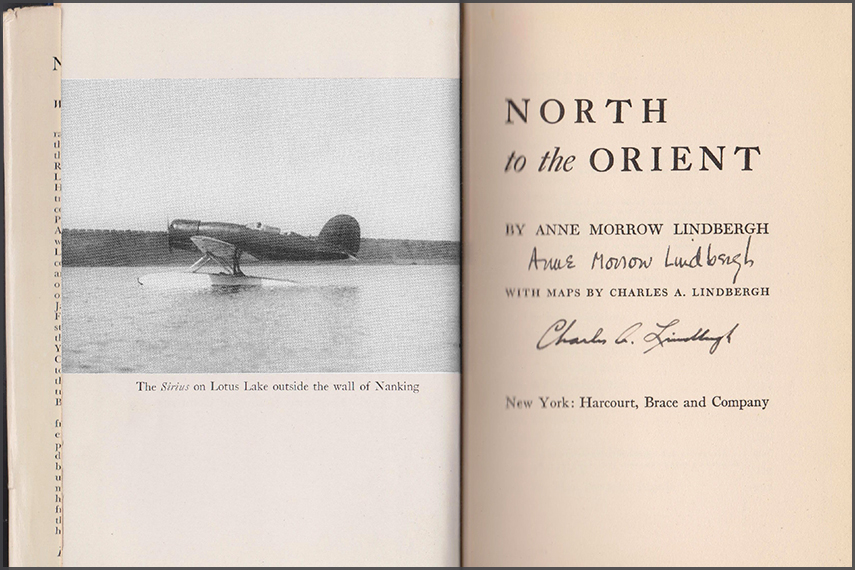
Dad wrote about their Nome visit:
"When the Lindberghs came thru on their trip to China Mrs Lindbergh was the operator. She was a beginner but sure bitten by the radio bug. They were in Nome 3 days and every day she was up at the station wanting to know more about radio. She was very nice. When they took off and headed toward Siberia I held contact until they reached the Siberian coast and she said 'good bye I'm going to try contacting the Russians.'"
* Wiley Post passed thru Nome twice on record breaking round-the-world flights, in his Lockheed Vega, Winnie Mae:
1) June 1931, with Navigator Harold Gatty, Post set a RTW speed record. After landing on a beach east of Nome to refuel, the propeller was damaged when the plane hit a patch of soft sand and nosed over.
Post pounded out the bent prop with a hammer and rock and flew on to Anchorage, where the prop was replaced. Post wrote about the flight in his book, Around the World in 8 days. Photos taken near Nome.
'Reg Robbins' flight ends'
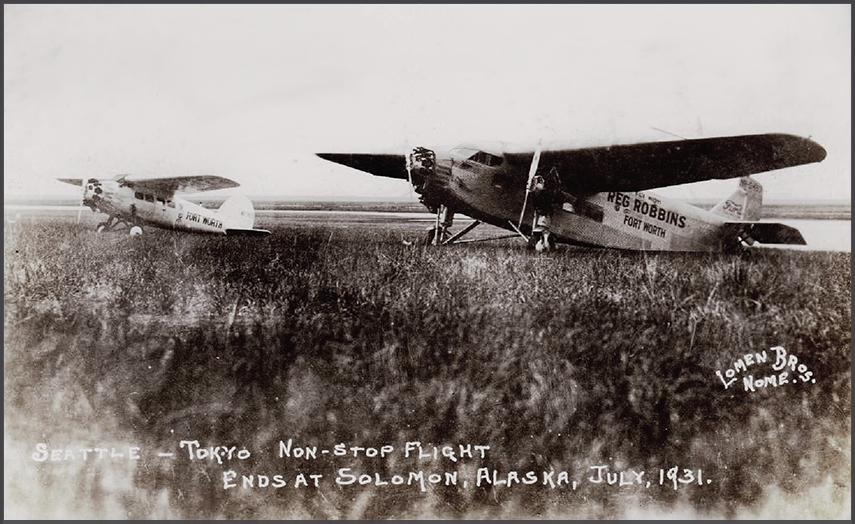
'Seattle - Tokyo Non-stop flight ends at Solomon,Alaska (July 1931)'
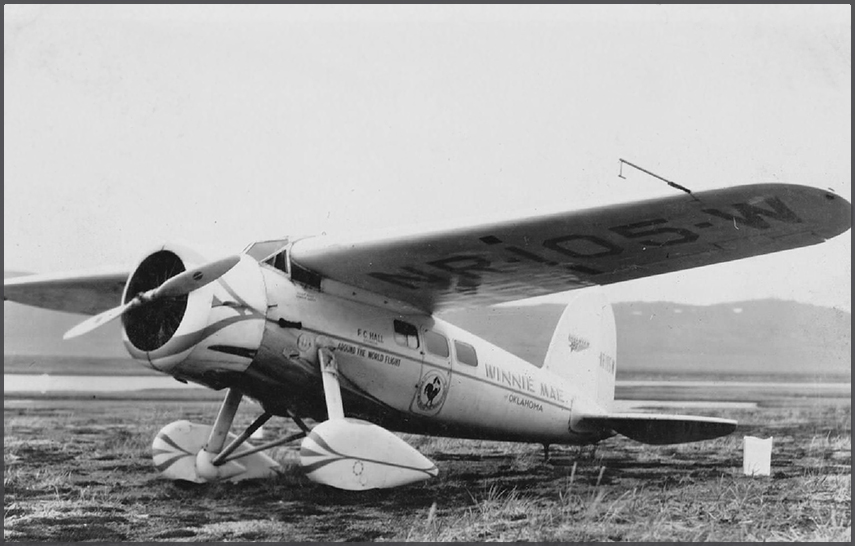
'Winnie Mae'
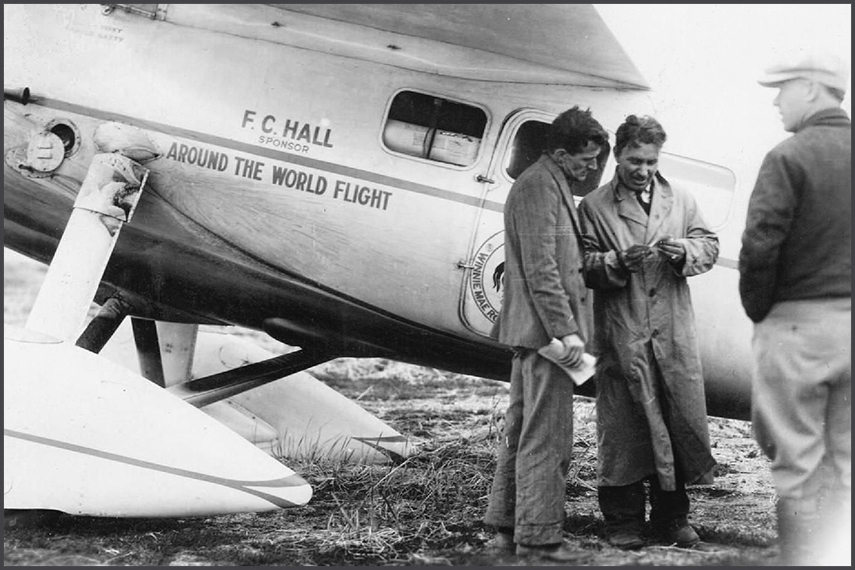
Sponsor: F.C.Hall 'Around the World Flight'

Harold Gatty and Wiley Post
2) July 1933, Wiley Post passed over Nome on his way to completing the first solo RTW flight. In 1935, he and humorist Will Rogers were killed in a plane crash near Pt. Barrow, Alaska.
* Reg Robbins, who’d previously set an endurance flying record (172 hours), twice tried and failed, in July & August 1931, to fly non-stop in a Lockheed Vega from Seattle to Tokyo using mid-air refueling from a Ford Tri-motor tanker plane. Both flights ended in Alaska, due to weather. Photo of Robbins' planes near Solomon,AK, above ↑
* Jimmie Mattern, who piloted the refueling plane for Robbins, crashed in Siberia while on a RTW solo flight attempt in 1933. He was escued by natives and flown on a Russian flying boat to Nome. In 1937, the Russian plane's pilot, Sigizmund Levanevsky, disappeared, with a crew of 6, while attempting a flight from Moscow over the North Pole to Fairbanks, Alaska.
Dad’s photo of the Russian flying boat arriving at Nome and an up close photo of the plane at Nome, from the book Sourdough Sky by Steven Mills, are attached.
en.wikipedia.org:_Jimmie_Mattern
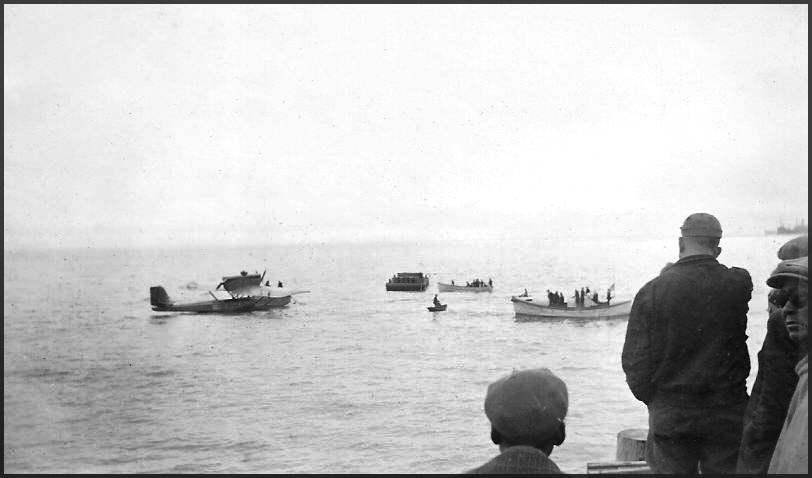
Jimmie Mattern returning from Siberia, July 1933. ↑
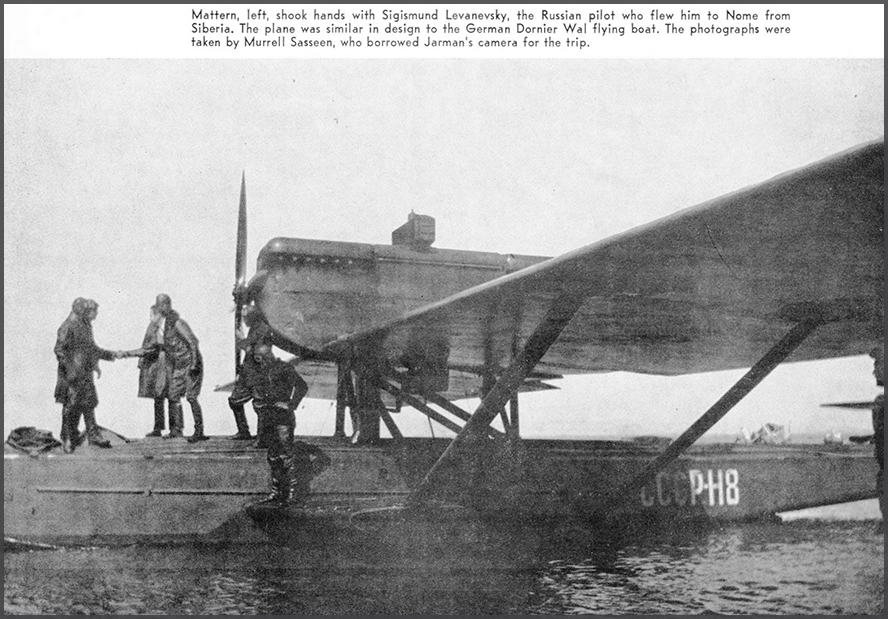
Jimmie Mattern (left) shaking hands with the Russian pilot, Sigismund Levanevsky, who flew him to Nome,AK from Siberia. The plane was similar in design to the German Dornier Wal flying boat.
The photographs were taken by Murrell Sasseen, who borrowed Jarman's camera for the trip. ↑
In a follow up email Charlie Burrow wrote me:
"My mother, Aileen Spaeth, grew up in Ketchikan, where she graduated from high school in 1921. Then, except for summers in Ketchikan, she spent the next 11 years in the States, attending college for 6years and teaching for 5 years.
When the junior college she was teaching at in Iowa closed down due to the Depression, in 1932, she returned to Alaska and took a job teaching elementary school in Nome.
When away from home, Mom wrote letters to her mother every week, religiously.
I inherited letters she wrote over a period of 4 years, beginning with her trip to Nome in Nov-Dec 1932.
She traveled by steamship from Ketchikan to Valdez, then by plane to Anchorage, Fairbanks and Nome.
The flights to Anchorage and Fairbanks were on a Northern Air Transport (NAT) plane, flown by pilot Vic Ross.
The last leg to Nome, on a NAT plane flown by Hans Mirow, was forced down for several days by weather at Koyukuk Station, a trading post on the Yukon River."

Plane of Mirow Air Transport - ©Charlie Burrow
Photos of Hans Mirow and his NAT plane. Over the next 2 years, while living in Nome and Candle,
Mom had many more contacts with Hans.
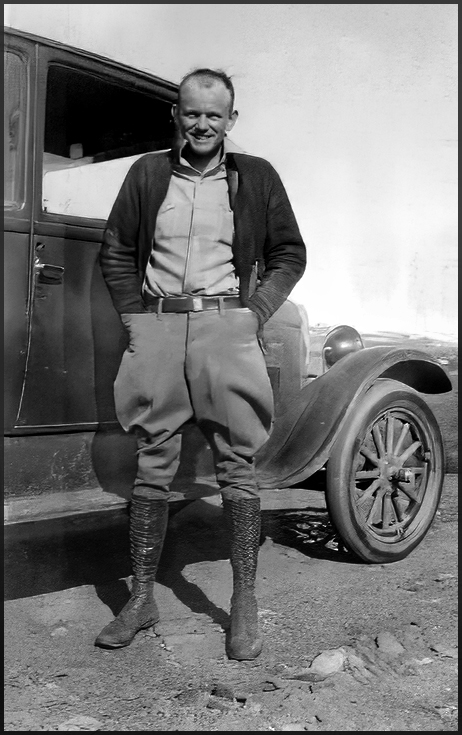
Hans Mirow @Nome,AK (©Charlie Burrow)
Charlie: "My mother finally arrived in Nome on December 11, 1932.
Following are excerpts from some of her letters:
------
Anchorage, December 5, 1932
Well, at last after four days, we have got this far on our journey toward Nome. I could have sent off another letter from Valdez on the Northwestern yesterday, but thought I'd better not, for fear you'd have visions of our getting marooned there for a few weeks.
It started to snow at Valdez Thursday evening and didn't let up until Saturday afternoon. It is an awful hole of a place, without even a movie to provide entertainment, so we were getting pretty bored and disgusted with the weather before we got away.
The bunch I was with were good sports and young, so things might have been worse.
There were five of us, the pilot, Vic Ross, Ruth Cameron, myself and two Fairbanks men, one who came down with Vic & the other was on the boat with us.
The hotel accommodations in Valdez are punk, but Ruth & I had a warm room & the boys were directly below us, where we could almost hear everything they said. No baths were available. The first night we were there the boys got out and stirred up a dance and we had a pretty good time there.
There was another Saturday night but we didn't enjoy it so much, partly because we were so disgruntled at the fact that we were still there. Outside of that all we had to do was play pinochle or go out walking in the snow. Friday & Saturday it was warm enough for us to have some good snowball throwing. Sat. we went out & swept the snow off the plane so it wouldn't endanger the wings.
Sunday morning the weather began to clear up and we got all ready to go, but Vic went up to look around first & then decided we'd better not try it. There is certainly a lot of work to getting a plane ready to fly in this country.
We all worked like troopers getting the snow & ice off of the wings & rudders, then the oil & the engine have to be warmed up for about an hour before it can be started.
We took off at 10:20 this morning & got here in about two hours, flying a longer route than Vic had originally planned.
It was a beautiful day and I enjoyed my first airplane ride very much. We came over mountains and glaciers all the way, and they certainly didn't offer any inviting places for emergency landings...
------
Fairbanks, December 6, 1932
We left Anchorage this morning at 11:15 and took just 3 hours to get here. The weather wasn't so fair as yesterday & we didn't get to see Mt. McKinley at all, which was a disappointment to me.
The air was pretty bumpy part of the time, but we all got thru safely - it was a good thing because the box we had been provided yesterday in case of need, was buried today under most of the baggage.
-----
Nome, December 12, 1932
I guess I've given you a pretty detailed account of our trip to Fairbanks which we reached last Tuesday. We left there the next morning with a different pilot, Hans Mirow, who makes his home in Nome.
Ruth & I & Mrs. Schwartz (the doctor's wife) were his passengers & what space we didn't have to have was filled with baggage & freight. I think I could have had 20 lbs more & no questions would have been asked.
The scenery this time was rather dismal & after we had flown about 2 hours, we got into snow, so Hans flew low & landed at the first convenient place, namely Koyukuk Station.
The girls said now I'd see some real Alaska homes as it was just an Indian village & we might have to sleep in the native's houses that night. You can imagine our amazement when we went up to the trader's house to find it electrically lighted & very comfortably furnished!
The other girls appreciated it more than I, I guess, because they had spent time in such villages before, but not in such a house. As we had to stay there 4 days we continued to be grateful that Hans had chosen to land there instead of some other place.
The trader at whose home we stayed is an Italian with a half-breed wife, but she has gone to school in Seattle, & was very clean, & how she loved to air her knowledge.
At dinner the first night the table was set, I'll have you know, with lace tablecloth & very nice cutlery & glass. And for food, there was nothing we asked for that couldn't be provided.
Mrs. Vernetti was very willing to let us do most of the cleaning & cooking, & there was plenty to cook. In fact, I never had such varieties of cheese, dishes with mushrooms & chestnuts & such, before. And plenty of garlic.
I have also learned to eat salmon strips (dried & smoked strips) just like candy, so I ought to be ready to try seal oil soon.
The women on the Yukon make very pretty moose-hide mocassins, both for outdoor & indoor wear, & Ruth & Pat each bought some. I have ordered a pair for house slippers, from Mrs. Vernetti, & if we'd been marooned much longer I think I'd have made them myself. I did a little practice work in beading the last night we were there, & amazed Mrs. Vernetti by doing it much better than the natives do, at the first attempt.
For amusement, outside of cooking, cleaning & baby tending (2 little girls, ages 1 & 3 1/2 yrs) we played bridge, pinochle, radio & phonograph, went out & got 3 Xmas Trees to bring to Nome, & had one dog-sled ride, my first.
Every morning we'd wait anxiously for weather reports from Nome, & usually they were rain & clouds.
Yesterday it looked pretty good at Koyukuk, & Hans got the engine warmed up in anticipation of good reports & when they came in he said "Let's go!" & we didn't waste any time getting started...
I guess we slipped in at just the right moment because it has been raining most of today. It would have been just too bad if we'd have had to land before we got here, because most of the snow is gone from the ground, & the ice is covered with water everyplace.
Hans heaved a big sigh of relief when he got us landed here with nothing worse than some skidding on the icy field.
There was no one to meet us except the company men.
-----
"Note: Lester and Irene Gore were friends of Mom’s family in Ketchikan. Lester was an attorney and was in Nome temporarily, serving as a federal district judge.
Their daughter, Nancy, who was born on the day Mom arrived in Nome, is the wife of former US Senator and Alaska Governor Frank Murkowski and mother of current US Senator, Lisa Murkowski."
Charlie |

To email me, click on the image and write the correct adress as given below
(replace -AT- by the @ symbol).

Sorry for the inconvenience, but this is because spam has increasingly become a problem.

|
Last updated:
15-Mrt-2026
|


