What we came for: the Rouen cathedral (French: Cathédrale Notre-Dame de Rouen) is
the seat of the Archbishop of Rouen and Normandy.

Very different styles in decorations, a proud heritage of many centuries.

A church was already present at the location in late 4th century, and eventually a cathedral was established in Rouen, as in Poitiers. It was enlarged by St. Ouen in 650, and visited by Charlemagne in 769.
All the buildings perished during a Viking raid in the 9th century, Rollo was baptized here in 915 and buried in 931, Richard I further enlarged it in 950, St. Romain's tower was built in 1035. The buildings of Archbishop Robert II were consecrated in 1065. The cathedral was struck by lightning in 1110.
Construction on the current building began in the 12th century in the Early Gothic-style for Saint Romain's tower, front side porches and part of the nave.
The cathedral was burnt in 1200.
Repairs and building proceeded in the socalled 'High Gothic'-style. Some windows are still decorated with stained glass of the 13th century, famous because of a special cobalt blue colour, known as 'the blue from Chartres'.
Wikipedia |

Building continued over centuries, but adversity struck repeatedly: lightning strikes, fires, storms and destruction by war.
Not all building was responsible or to last, some of it needed replacement or restructuring. But the cathedral
grew in majestic
proportions. And I am thrilled considering the history of this location, e.g. this cathedral had a strong musical tradition
since the Middle Ages; its choir was famous, up to the French Revolution, for singing from memory. WIKIPEDIA

Richard Lionheart's
tomb in Rouen's cathedral. Actually, only his heart is kept here. And last year his heart made the news, after eight centuries!
When embalmed after his death in April 1199, the heart of King Richard I was soaked in frankincense.
Philippe Charlier, a celebrity French pathologist who specialises in the coldest of cold cases, told: "We found many interesting things," he said, "but the most interesting was the presence, in substantial quantities, of frankincense; which has never been found in any other embalming. It is unique.
This suggests that Richard, and those around him, knew of episodes in his life which had a bad smell... Frankincense, linked to Christ’s story, may have been intended to make him smell like a saint and therefore to ease his passage to heaven." www.independent.co.uk/news |

The sign was promising, but it was not clear to what the text referred to. Repairs indicated a vault had been closed?
A bit disappointing, but here is the story of Queen Matilda ( Empress Matilda - the 'Lady of the English'):
King Henry I of England had two legitimate children. William and Matilda.
William was killed during the White Ship disaster. The impact of White Ship disaster was that it left Henry with no male heir. Henry then called upon all his chief noblemen to swear that they would take Matilda for their queen in England, and their duchess in Normandy, after his own death.
Young Maude, her Latin name was Matilda, was married to the German Henry V, the Holy Roman Emperor. Her husband died in 1125 and Matilda returned to England.
In 1127 she was forced to marry Geoffrey of Anjou. It was a tempestuous marriage, Matilda left her younger husband (he was 11 years her junior) but was reconciled and produced three sons. The eldest son was Henry, who was born on March 5, 1133 (later, King Henry II of England). Her second son was Geoffrey, Count of Nantes and her youngest son was called William.
Matilda's father, King Henry I of England, died in 1135. Matilda was ready to take her place as Queen of England. Neither English nor Normans had ever been ruled by a woman, and Queen Matilda, the Empress Maude, as she called herself, was a proud, disagreeable, ill-tempered woman, whom nobody liked.
Maud did not make herself popular in England. A revolt put her in prison. She was so proud and violent, that her husband would not even come over to England to help her, but remained put to govern Normandy!
She escaped by lying down in a coffin, with holes for air, and being thus carried through all the country.
When besieged in Oxford Castle, she once more escaped. One night, Maude dressed herself and three of her knights all in white, and they were, one by one, let down by ropes from the walls. They crossed the river on the ice, walked a great part of the night, and at last came to Abingdon, where horses were waiting for them.
Quite a woman!
Matilda had no further desire to be queen, but lived a retired life in a convent, and was much more respected there than as queen. Matilda died at Rouen in France; her epitaph here reads:
"Here lies the daughter, wife, and mother of Henry."
More can be read here: www.lordsandladies.org/queen-matilda.htm
|

Perhaps this is Matilda's tomb, I could find no reference. But the head has been
touched in reference so many times that lines have worn away over time. So it could well be.

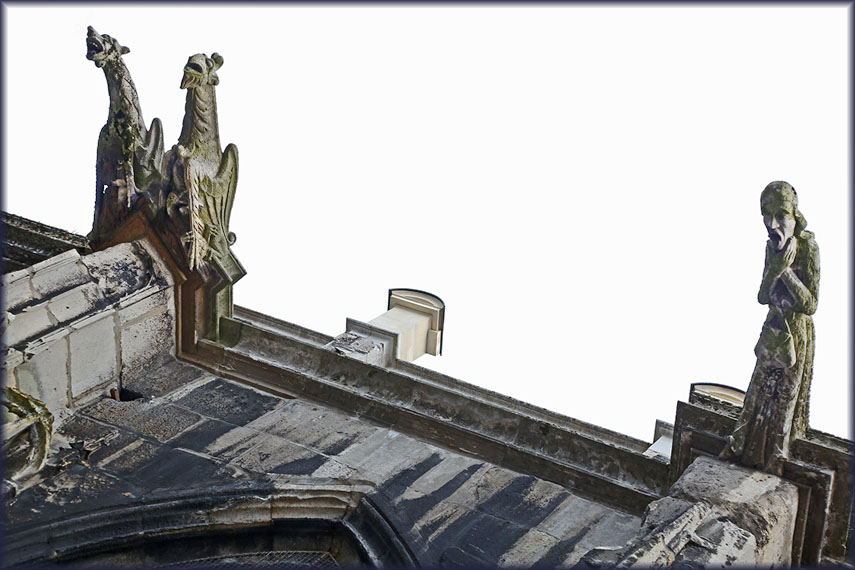
Some of the decorations of the cathedral's exterior, a good chance to see these figures up close.


Lighting a candle.

A prayer in privat.

World War II
also brought destruction to Rouen and to the cathedral in particular, during the bombardments by the Allied armed forces.

We are fortunate to be able to enjoy the intricate decorations, which
have withstood
the forces of Nature, and destruction by Men, over so many centuries.

|
 Photos © Ruud Leeuw