Photos © Ruud Leeuw
Photos © Ruud Leeuw
Photos © Ruud Leeuw
| When I visited Hemet-Ryan Airport on 14May08, my initial goal was the CDF (now Cal Fire) airtankers here.
|
 Beech G18S N5BA of Oleetho-3 Inc. ( Riverside,CA) was registered on 14Sep06 |
 In the cafetaria I was introduced to the airport manager, who gave me his permission to walk across the ramp to where I had seen another Beech 18. He also said to look out for 'Doug' who had a few planes I might be interested in...
Expecting to be back in 10 minutes, I postponed my cold drink and walked to the hangars. I was in for a surprise! |
 N62936 is a Beech D18S (CA-38), registered in 21Feb08 to Prop & Jet Air Museum (Riverside,CA).
It features splendid nose art: 'Sweet Dreams'. Some close ups of this 'Mini DC-3' on the presentation at the bottom of this page. I also met Douglas 'Doug' Medore, who was getting his hands dirty on some small engine. |
 Doug Medore is a pilot for UPS and also flies 'Sweet Dreams'. He opened hangardoors for me and they were all filled to maximum capacity with planes, cars and motorcycles! I did not expect to see a Fokker Dreidecker here at Hemet!! The tailnumber is N113PC and FAA's Registry showed the following details: Serial 1 - Manufacturer ML.Childers & P.T. Combs - Model Fokker DR 1 - Manufactured 1982 - certificate issued 07May2008 - Type engine Reciprocating - Owner Prop & Jet Museum. More images see the presentation at the bottom of this page. |
 Outside the Airport Café I had seen a sign to a museum (Ryan School of Aeronautics Museum ?) but no aircraft on display... So to find this treasure trove, with only a sign Prop & Jet Museum on a hangar largely hidden from view by other hangars, was quite a surprise! The above mean machine is a Ryan Aeronautical ST3KR, N56565 c/n 1431, registered to PROP AND JET AIR MUSEUM on 21May08. |
 This is a Cessna 195A, manufactured in 1951. N1057D (c/n 7669) was registered to Twin D Enterprises of Diamond Bar,CA on 21May1999.
The Cessna 190 and 195 are light single engine general aviation aircraft which were manufactured by Cessna between 1947 and 1954. The 195 model was also used by the United States Air Force as a light transport and utility aircraft under the designation LC-126. The Cessna 190/195 aircraft were Cessna's only postwar radial-engine aircraft. The first prototype (named P-780) flew in 1945, after the end of World War II. The biggest difference between the 190 and the 195 models was the choice of engine. The 195 used a Jacobs R-755-A2 radial engine with around 300 hp or a Jacobs R-744-A2 with 245 hp, while the 190 used a Continental R-670-23 radial engine with 240 hp. The Cessna 195B model used a Jacobs R-755-B2 engine of 275 hp. 233 190's were built as well as 890 195's. Fewer than half survive. For most pilots the aircraft was too expensive for private use. Therefore, they were sold mainly as a business aircraft, and thus they were called businessliners. The LC-126 military version was mainly used in Alaska and could be fitted with skis or floats. 83 LC-126's were delivered. Few are still airworthy. Source: WIKIPEDIA |
 Piper J3C-65 NC58368 (c/n 8939), manufactured in 1942, registered since 01Jun07 to Michael R. Ratliff of Hemet,CA. |
 This Yakovlev Yak- 52 N2327Y (c/n 888704) is also registered to Twin D Enterprises, since 01Feb2000. |
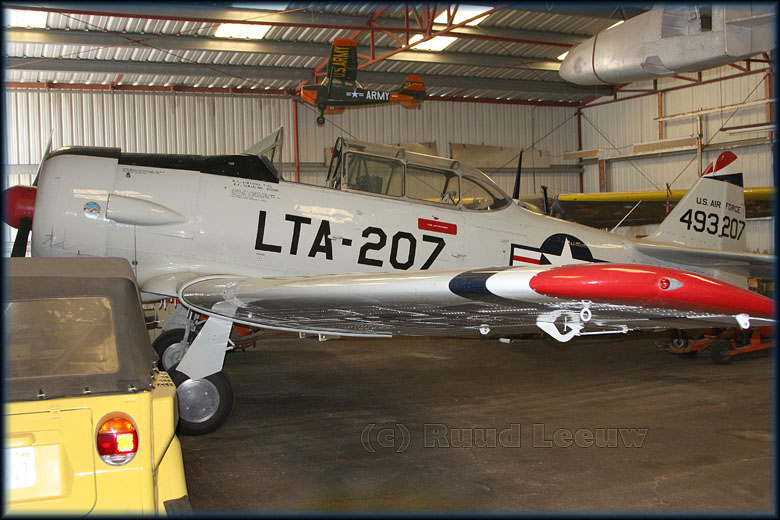 North American T-6G Texan, N3100G (49-3207), registered on 28jan80 Arthur D. Medore (of Denville,NJ) |
| Probably not part of the museum but worthy of inclusion, I thought...  Cessna 185A N80410 (c/n 1850372), manufactured 1962, registered to Howard M. Bohl Jr of Temecula,CA (08Dec06). |
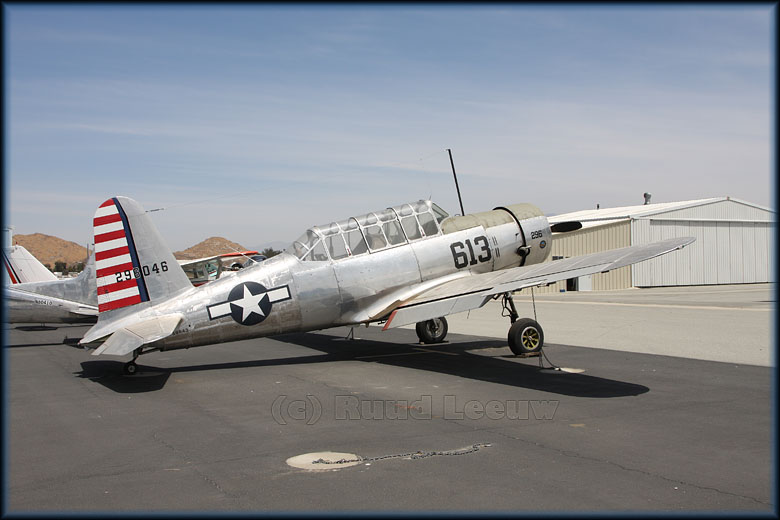 Consolidated BT-13B Vultee/Lacey N59843 (serial 9244L), registered 04Feb99 to Douglas A.Medore of Diamond Bar,CA With retractable landing gear and a powerful engine, the Vultee V-54 basic combat trainer was too lavish for the cash-strapped United States Army Air Corps of 1938. So Vultee redesigned the aircraft and made it less complicated. The first order for 300 new BT-13 Valiants was placed in September of 1939, and it would become the most widely-used American training aircraft of WW2. The Vultee BT-13 had a continuous canopy with its crew of two sitting in tandem behind dual controls. It was also equipped with blind flying instruments to teach new pilots the basics of flying at night or in foul weather. BT-13 students soon gave the airplane a nickname which described its most memorable characteristic: Vultee Vibrator. The only major variant of the BT-13 was the BT-13B, which featured a revised electrical system. Because of the speed with which the BT-13s were built, there was soon a shortage of Pratt & Whitney Wasp Junior engines. To overcome the shortage and maintain production levels, the BT-15, using a Wright Whirlwind engine, was then introduced. 2.000 BT-13s and BT-13Bs were transferred to the US Navy, where they were designated the SNV-1 and SNV-2B. When production ceased in 1944, 11,537 Valiants had been produced. The Valiant was retired at the end of the war, but over 100 of these aircraft are still registered in the United States today, although it is believed that less than half are actively airworthy. Source: www.warbirdalley.com |
| When I got back to the Airport Café for that well-deserved cold drink, I had some explaining to do! Expecting to be gone for 10 minutes, I had stayed away for almost an hour... Good thing I had the car keys with me or otherwise my wife would have driven off without me! Anyway, I had that drink and we had an excellent lunch while I munched over that excellent collection I had seen! |

CDF AIRTANKER AT HEMET-RYAN AIRPORT
|