Aviation Photos & History from Neville Webb

PAGE ONE | PAGE TWO

A word about (and by) Neville Webb's interest in aviation:
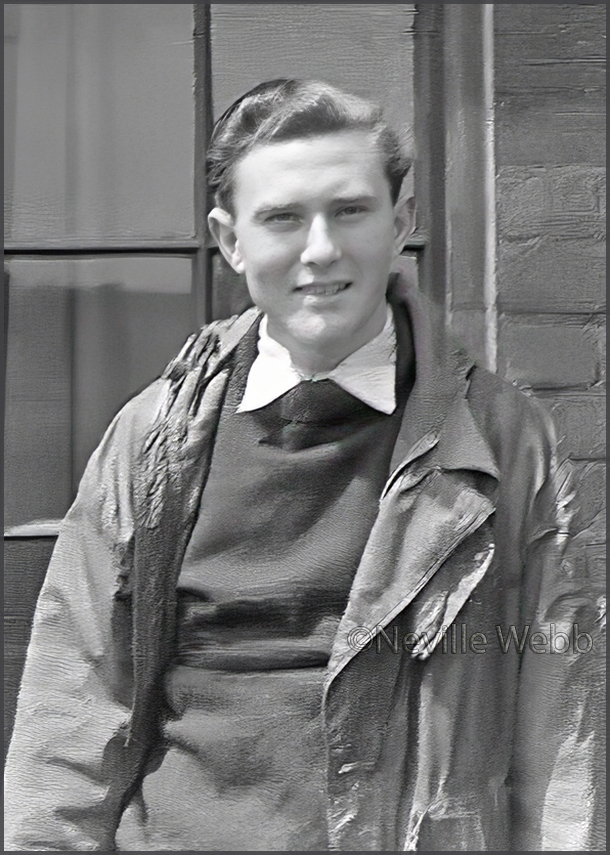
I have always been interested in aviation, aircraft and flying. As part of my apprenticeship with the Ministry of Supply (1954-59), I worked at aircraft servicing at RRE Pershore (1957-58) and RAE Farnborough (1958-59).
Was in the Air Cadets for five years and Glider solo at RAF Hawkinge (1957), and a member of the RAE Gliding Club, Farnborough. Gained my Private Pilot Licence (PPL) in 1971 at Swift Current, Saskatchewan, and on moving to Newfoundland in 1972 continued to fly for a few years and later as an 'up-front' passenger.
I found myself teaching at the 'fly-in' Community of Sandy Lake First Nation, NW Ontario (1955- 2005); one experiences a close up look at passenger flying in and out of small, isolated northern communities.
Having a camera readily to hand lets you take advantage of any opportunities to photograph those older aircraft whose remaining work lives usefully continue in the North
.

FOR LATEST UPDATES --->> To bottom page

Opening the 2nd page of Neville's AVIATION HISTORY on my website: 'here is the submission for the
SBAC 1959 airshow at RAE Farnborough with photos I took at the time.
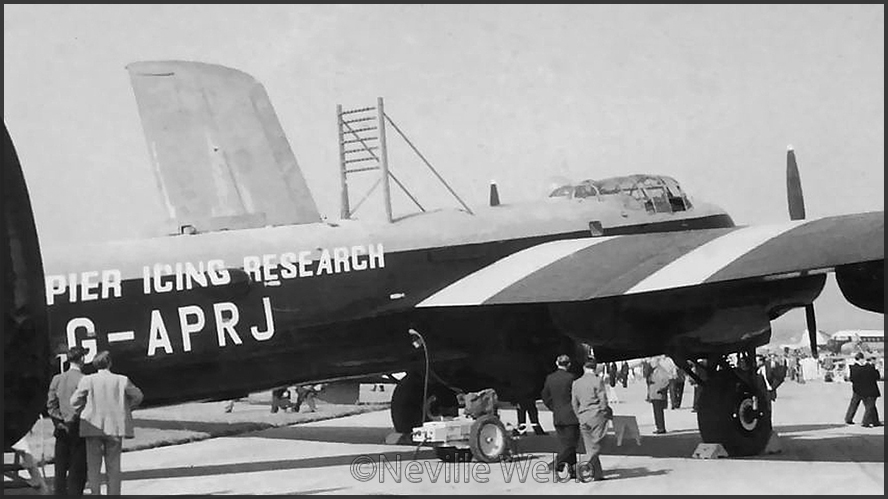
SBAC 1959 at Farnborough; AVIATION HISTORY by Neville Webb
SBAC 1959 at Farnborough; PERSONAL AVIATION HISTORY by Neville Webb
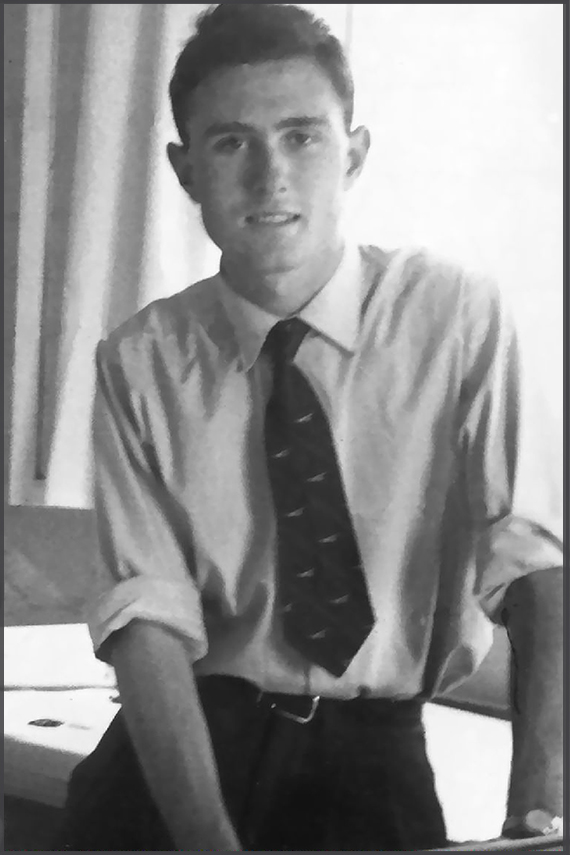
SBAC 1959 at Farnborough; AVIATION HISTORY by Neville Webb
Portrayed in back of the day..

Neville: "It was my good fortune to be transferred from RRE Pershore (see PAGE ONE) to RAE Farnborough for the final year of my apprenticeship with the Ministry of Supply before being drafted into the Royal Air Force. Indeed, 1958 and 1959 was an interesting and happy time: I lived in the RAE Apprentice Hostel and gliding at the airfield in the summer of 1959."

"From 1958 to 1959 I worked on aircraft in D Shed (Hastings, Canberra) and even an Avro Ashton in E Shed.
Then a move across the airfield to the Empire Test Pilots School (ETPS), followed for a short while in Progress and Planning.
I also attended the RAE Technical College taking Airframe and Power Plant courses.
Being in Progress and Planning at the time of the 1959 airshow I was able to freely access the airfield and the indoor exhibitions and take photos.
During the display the 'pilot' of the Hovercraft waved to me to get on board for ride along the runway; not a good idea to sit next to the very loud and deafening exhaust of an Alvis Leonides engine!
The 1950's and 1960's have been described as the 'Golden Years' of British Aviation with well know names of aircraft manufactures including Airspeed, Avro, Bristol, De Haviland, English Electric, Fairey, Gloster, Handley Page, Hawker, Percival, Saunders Roe, Scottish Aviation, Vickers, Westland together with their innovative aircraft designs and production aircraft."

SBAC 1959 at Farnborough; AVIATION HISTORY by Neville Webb
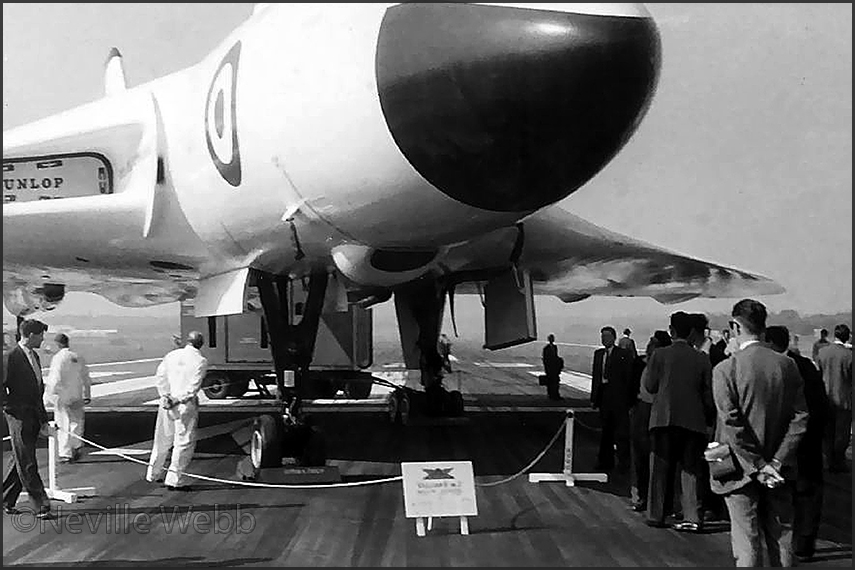
V-bombers appearing on the scene of the RAF
History of Farnborough Airshow: 1948-1972 www.farnboroughairshow.com/resources/news-blogs - -1948-1972
SBAC 1959 at Farnborough; AVIATION HISTORY by Neville Webb
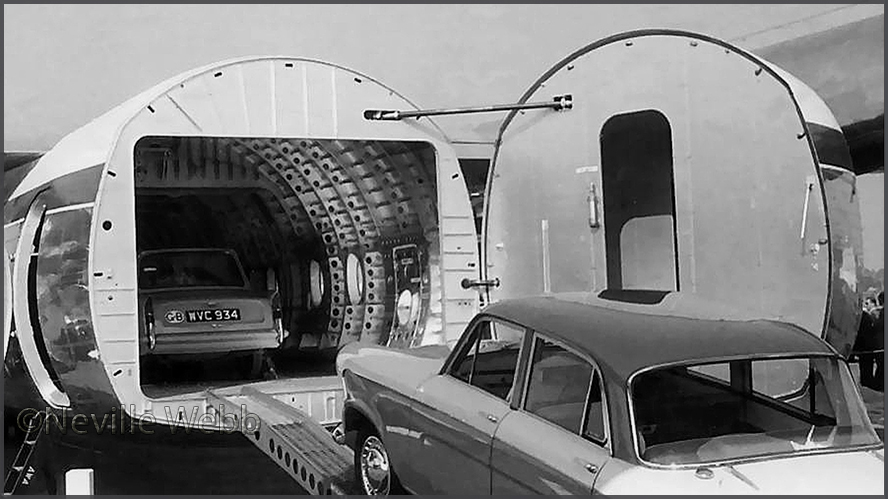
This must be a twin-boom design but difficult to make out the type.. Seems shiny and new.
Perhaps the Armstrong Whitworth AW.660 Argosy? "On 08Jan1959, the first Argosy performed its maiden flight.
It appeared during that year's Farnborough Airshow, by which point five aircraft were flying, having cumulatively
amassed about 400 flight hours between them.
" EMAIL
Carferries thru the air (into France mainly) were the hype in England back then!

Society of British Aircraft Manufacturers (SBAC) Airshows 1948-2000: raefarnborough.tripod.com/sbac
"The SBAC, the Society of Aircraft Manufactures was formed during World War One. It brought together all the aircraft firms in one representative body. The first Annual Displays were held as part of the annual RAF display in the early 1930's. By the end of the decade a dedicated show was taking place annually.
After World war Two the first show took place at Radlett, Hertfordshire in 1946.
There was no room for the public at this event, and, after considerable pressure was moved to RAE Farnborough in 1948. The show was open to visitors from the aircraft industry on Tuesday 7th to Friday 10th September. Saturday and Sunday being open public days
."

SBAC 1959 at Farnborough; AVIATION HISTORY by Neville Webb

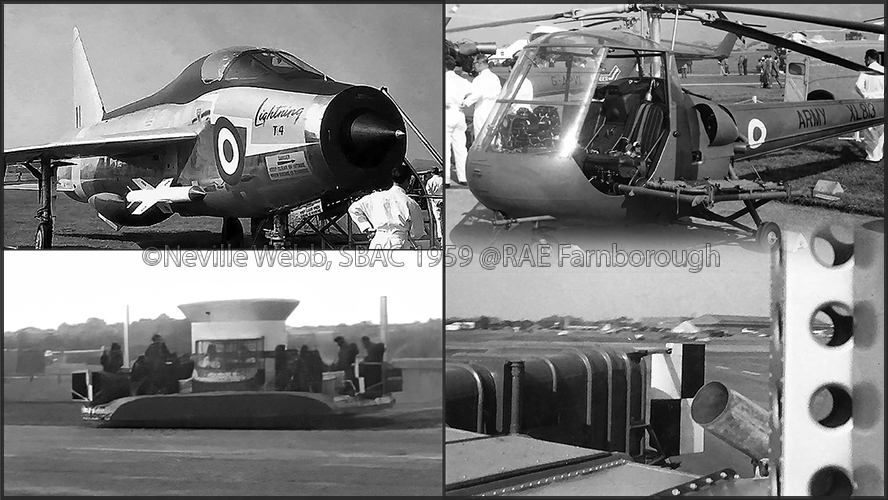
Neville: "The photo at the lower right of the collage was taken by me while sitting the port side bleed air ducting of the Saunders Roe SR.N1 Hovercraft.
Ducting each side of the vertical centre ‘funnel’ took bleed air from the funnel and directed it to square section longitudinal fore-after ducting to flow over small rudders which provided directional control for the hovercraft.
In the photo you’ll see the exhaust stub from the horizontally mounted single-row radial engine mounted inside the funnel.
As mentioned the pilot/driver waved to me to get onboard for a ride as the only exterior passenger...
Definitely not the best place to sit as the extremely loud pulsing exhaust noise was deafening, if not painful!
The other photo of the SR. N1 shows a small contingent of, I believe, Royal Marines on board the hovercraft.
The small helicopter also shown in the collage is the Saunders Roe Skeeter.
All submitted photo were taken by me at runway side or during SBAC Trade days."


SBAC 1959 at Farnborough; AVIATION HISTORY by Neville Webb
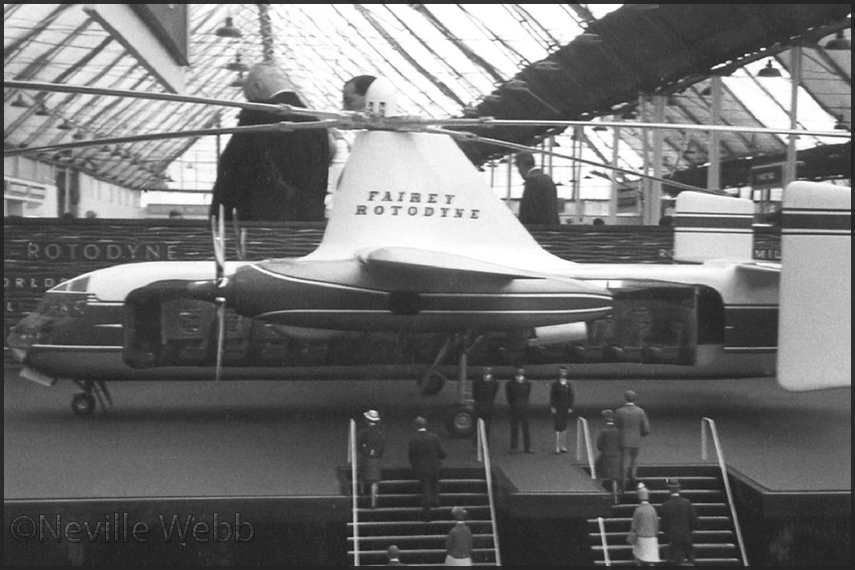
Photo of a scale model (note the persons in the background). I remember how my father and I (RL) sat down
assembling scale models he made one of these including the see-thru transparency on the side, showing the seating.
Long, long time ago..!
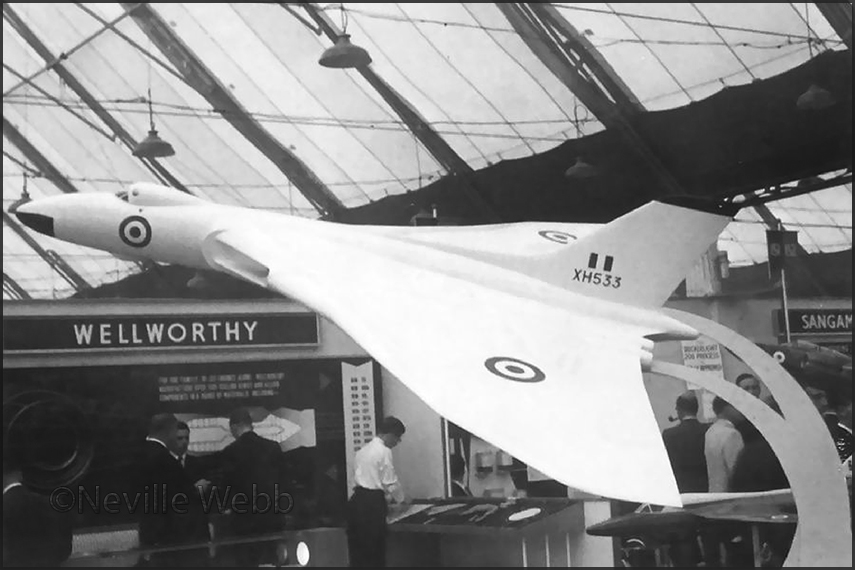
SBAC 1959 at Farnborough; AVIATION HISTORY by Neville Webb
For decades the pride of the RAF: the Vulcan!

"Would be nice to go back in time and rephoto the parade of aircraft."
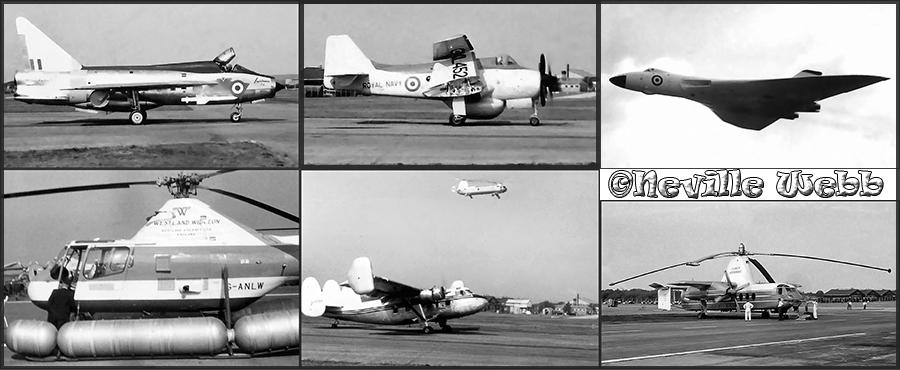
SBAC 1959 Display @Farnborough
In no particular order: Avro Vulcan + Westland Widgeon + Fairey Rotodyne + Scottish Aviation Twin Pioneer [Magnetic Survey] + a Bristol Belvedere HC1 helicopter.
Many of the aircraft shown made by companies that no longer exist or gone due to amalgamation into manufacturing groups.

Photo Library 1955 Farnborough Airshow 1955: ABPic.co.uk/pictures/airshow/Farnborough


Alvis Aero Engines
Caption 1:

Alvis Aero Engines
Following National Service in the Royal Air Force in 1961 I began a three year program at Shoreditch College, London University, Egham Surrey.
One requirement to complete this program each student was required to write a study related to Craft work to be produced in a single copy 'book' format.
Craft was a term at that time that could be understood to mean a craft skill or a trade skill. Since I had completed an apprenticeship trade training as an Aircraft Fitter I decided to write my study on the trades involved in terms of the Craftsman's Contribution to Aeronautical Development. This required getting trade skill data from manufactures in the UK aircraft industry.
Only two manufacturers responded positively to my request for relevant data. These were the Alvis Aero Engine Division at Coventry and De Havilland at Hatfield.
Vickers at Weybridge did provide various VC10 airframe photos and of their computer hardware. Disappointingly, the Science Museum in London refused access to their historic aircraft collection. It should be noted 1960 was the time before the present-day widescale activities and projects to restore or recreate vintage aircraft the Internet.
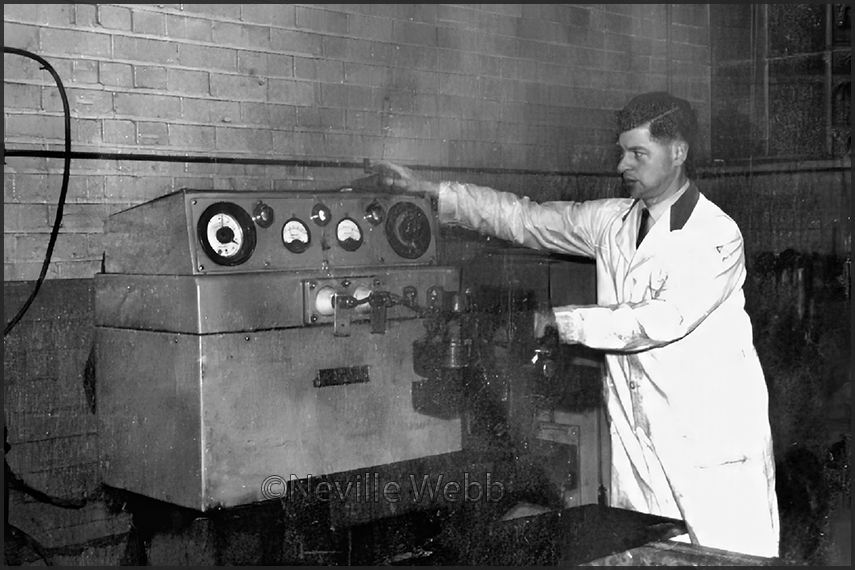
However, most helpfully in the summer of 1960 Mr. Varney of Alvis arranged a two day visit for me to visit the Aero Engine Division, go through the departments of aero engine production and testing and take photographs. These departments were the foundry, assembly, machine shop and engine test cell. Many grateful thanks to Mr. Varney.
Chief Engineer Aero Engine Division: Arthur. F. Varney
Citation: Motor Magazine: www.motorsportmagazine.com/archive/article/march-1993/68/arthur-varney/
In 1933 he became assistant chief engineer in charge of aeroengine manufacture, designing the Leonides radial engine first fitted to the Bristol Bulldog fighter. During the war he was responsible for nine shadow factories overhauling power plants for Spitfire, Lancaster and Wellington aircraft. After the war, apart from fixed wing aircraft and helicopters, his team built the power-unit for the first hovercraft.
The following Links and citations below provide information about the history of Alvis including it's aeroengines and the more widely known famous cars.
Alvis Car and Engineering Company Ltd
en.wikipedia.org/wiki/Alvis_Car_and_Engineering_Company
Alvis Car and Engineering Company Ltd was a British manufacturing company in Coventry from 1919 to 1967. In addition to automobiles designed for the civilian market, the company also produced racing cars, aircraft engines, armoured cars, and other armoured fighting vehicles. Car manufacturing ended after the company became a subsidiary of Rover in 1965, but armoured vehicle manufacture continued.
Alvis Car Company Heritage
https://thealviscarcompany.co.uk/our-heritage/
Citations: On November 14th 1940 the car factory was severely damaged by the German Luftwaffe’s raid on Coventry although the armaments factory was relatively undamaged. Car production was suspended for the duration of the war only resuming during the latter part of 1946. But Alvis carried out war production on aero engines (as sub-contractor of Rolls-Royce) and other aircraft equipment. As their part in the war effort Alvis were responsible for operating 21 'shadow' factories.

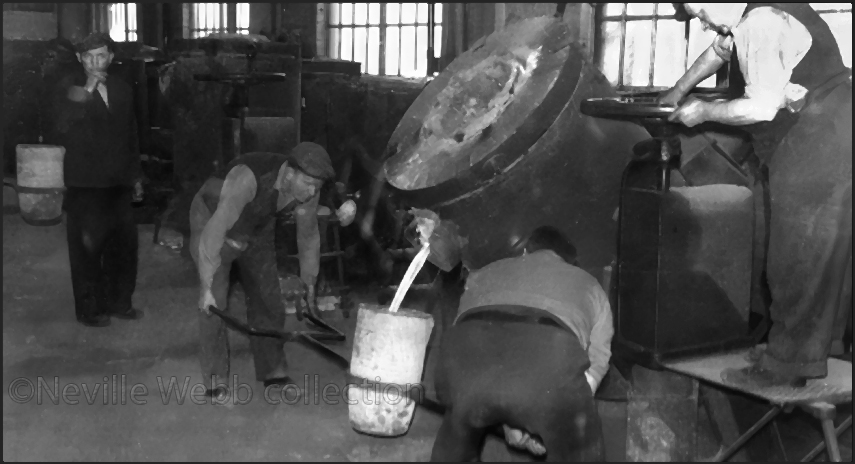
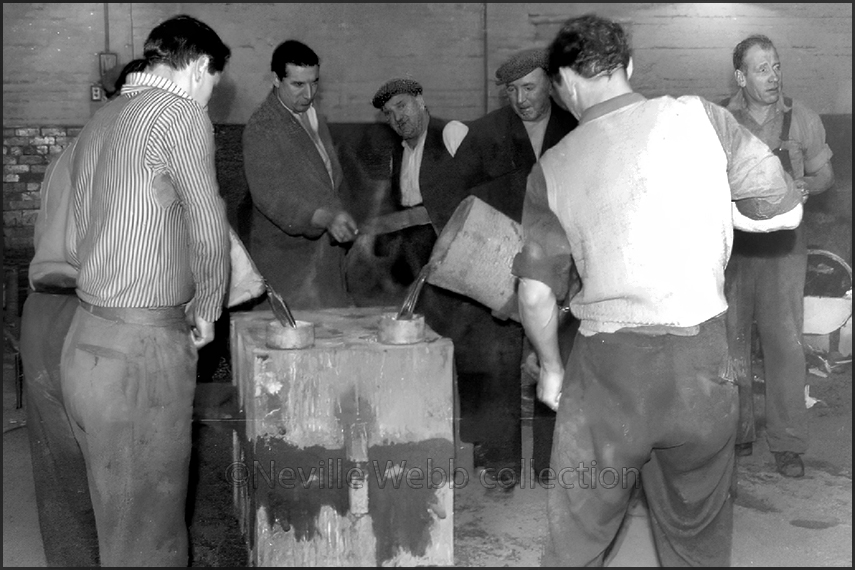
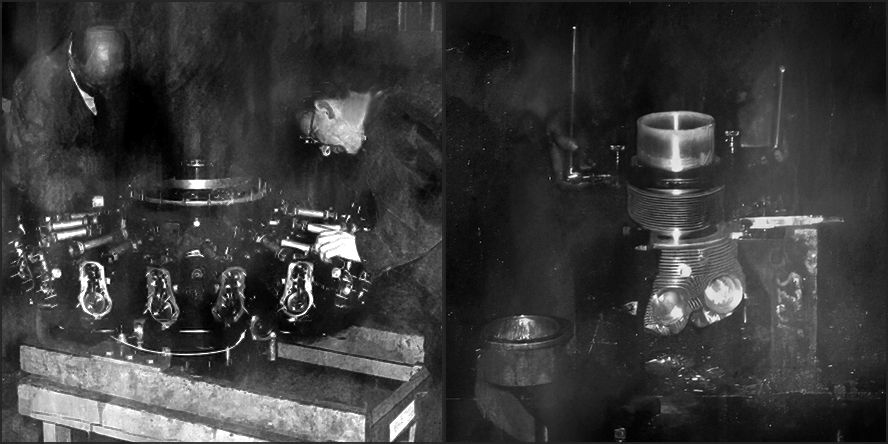
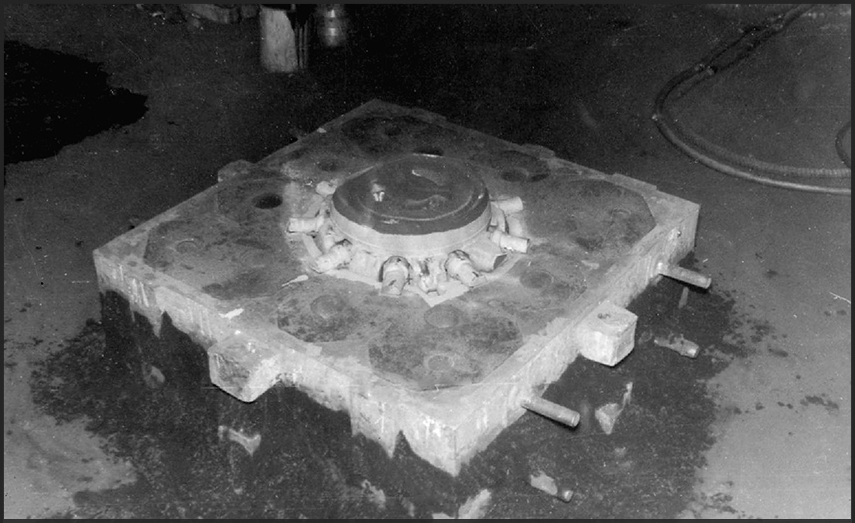
"These pictures show pouring aluminum into a mould for a section of Leonides engine crankcase; engine assembly and I believe/recall shrink fitting of a cylinder liner - need to check that.
As a point of interest Napier had to request help from Bristol Aircraft for the manufacture cylinder sleeves for the Napier Sabre engine.
For some reason this morning I checked the Shoreditch College site(s) and note five (my) photo albums of strident projects still exist. It seems over the years few others if any took similar photos."

Alvis Aero Engines
These foundry photos show aluminum being melted in a small furnace and being poured into
socalled casting boxes containing pattern.

Alvis Aero Engine Manufacturing: https://aeroenginesaz.com/en/brand_alvis
The initial Alvis aero-engines were licence-built Gnome-Rhone radials. The first aero-engine designed and built by Alvis was the 14-cylinder Alvis Pelides radial in 1936. Development of this and related engines (Pelides Major, Alcides, Alcides Major, Maeonides Major) was stopped with the start of the Second World War with only a handful built.
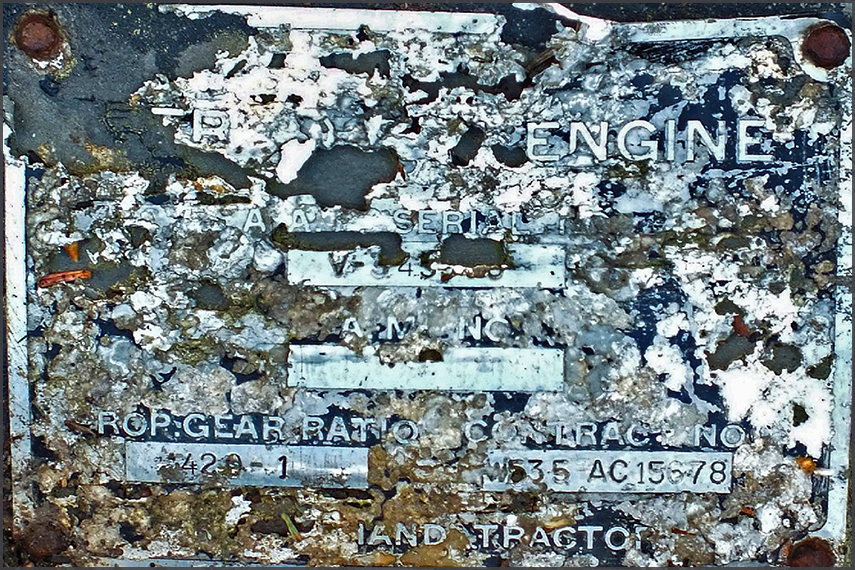
The Alvis Leonides, a smaller 9-cylinder radial, continued in development during the war and was used after the war in some aircraft and helicopters until production finished in 1966. In 1952.
https://alvisarchive.com/aero-engines/
Book by  Roy Probert ‘Leonides’ –The Alvis Aero Engine
Alvis Leonides Aero Engine: Wikipedia:  en.wikipedia.org:_Alvis_Leonides

Alvis Aero Engines
Shrink fitting cylinder liner into forged aluminum cylinder head, and Crankcase sections assembly.

Alvis Aero Engines 1950s
One part of Crankcase Pattern

Alvis Aero Engines 1950s
Preheating Cylinder Head prior to cylinder liner fitting.

Shoreditch College Photos.
Years 1961-65 – Exhibition photos contributed & organised by Neville Webb.
╬ 1963 Exhibition (could possibly be 1962) ╬
╬ 1964 Exhibition ╬
╬ Exhibition and Student Work 1964 ╬
╬ Exhibition and Student Work ╬
╬ Workshops and Student Work ╬
╬ <> ╬
These external links show photos taken by me showing examples student work in year end exhibitions.
Surprisingly it seems no other student bothered to photograph exhibition work! Shoreditch College was originally
located in Shoreditch, London. The College philosophy was firmly rooted in Craft Tradition and skills. It is now
gone and the buildings and workshops demolished. The college was located next to the Royal Air Force Memorial
at Runnymede. en.wikipedia.org:_Air_Forces_Memorial
 

Neville wrote me this in March 2026:
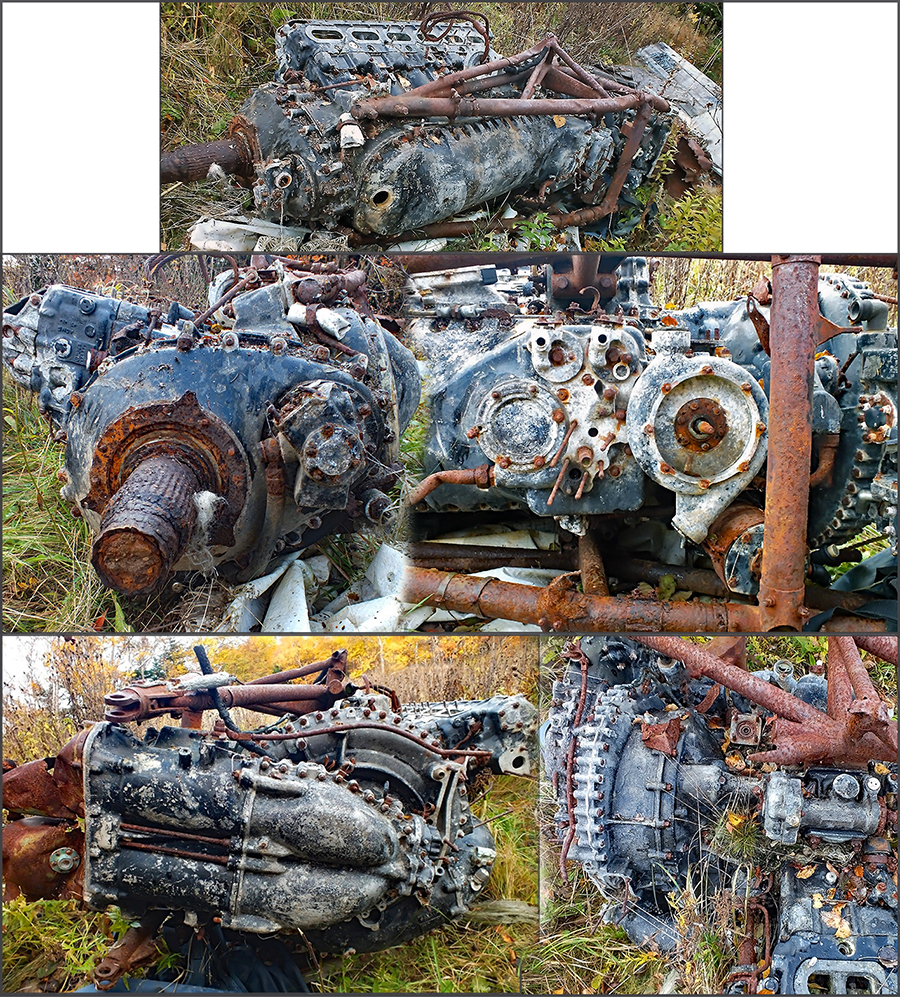
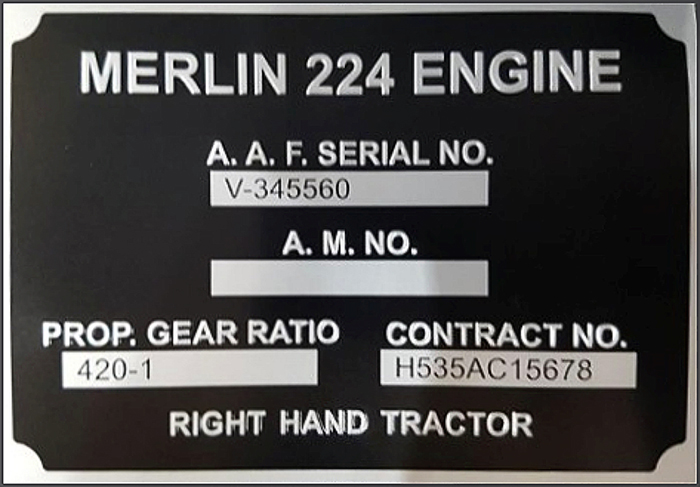
"There's no official record of an Avro Lancaster being buried at YYT - but a RR Merlin engines was found protruding out of a bank side and will include my photos of this engine.
Story or Legend or Myth: Lancaster Buried at St. John's International Airport (YYT)
Once in a while there's talk around the local aviation community, and in the hangers, about an Avro Lancaster buried at this airport. However, there is no record of an Avro Lancaster being buried at YYT...
It's likely true that immediately post-WWII some aircraft were buried at wartime airfields around the world. Also, unwanted WWII aircraft were disposed of by simply pushing aircraft off the decks of aircraft carriers into the ocean.

A search was made for Spitfire fighters reportedly buried in their packing crates at Rangoon Airport without result. Recovery of buried WWII aircraft these days is done in Archeological terms at known crash sites for historical purposes of leading to restoration of an aircraft to museum or flight status.
The story I was recently told about a Lancaster being buried at YYT was that the 'aircraft' was rolled over a bank and into a hollow area of ground and filled over... Later, an aerial could be seen sticking out of the ground.


Many engine parts stripped from the engine, including coolant pump and crankcase drain plug.
Mystery of Lancaster engine at Torbay-YYT

RR Merlin Engine at YYT:
While there is no mention in official records of a Lancaster being buried at YYT a RR Merlin engine was recovered after being noticed partly sticking out of the ground.
This engine is in the possession of Bob Maher who's rebuilding the rear fuselage of RCAF B-24 Liberator 856, recovered from Labrador.
I was able to photograph this RR Merlin engine while it was lying in an off-airfield area. So, maybe there's some truth in the story of a buried Avro Lancaster at YYT, or at least a section fuselage or other parts.
While researching this story I found an online website with a photo of Lancaster Mk.X CX954 -at YYT- with a collapsed right side undercarriage, the result of a heavy landing.
The story of a Lancaster buried at YYT may be the result of confusion with an Avro Lancaster that crashed at Gander and then stored, later said to be buried under the location of present airport terminal. But, the Legend lives on...

Mystery of Lancaster engine at Torbay-YYT
Neville: II moved around the engine a few times to ensure photo coverage. Close by the Merlin was another damaged front engine crankcase and cowling from the RCAF Liberator recovered from Labrador. I’d not seen those before."


FURTHER READING>>>
Avro Lancaster Mk X aircraft in Post War in Canada:
www.lancaster-archive.com/lanc_postwar-canada
RCAF Aerodrome Torbay:en.wikipedia.org:_St._John's_International_Airport
Citations as follows: ' St. John's Airport is still commonly referred to as "Torbay" within the aviation community.
For example, in aeronautical radio communications, air traffic controllers, flight dispatchers and pilots refer to the weather in "Torbay" and in flight clearances controllers commonly clear aircraft to or over St. John's with the phrase "Cleared direct Torbay".
In the latter case this is a clearance to the VOR (VHF beacon) serving the region, which continues to be named Torbay on all official aeronautical charts.
In addition to tradition, this usage avoids confusion with Saint John, New Brunswick, also in Atlantic Canada. Additionally the "T" in airport codes CYYT, and YYT, continues to reflect the Torbay origin.
Aerodrome:
In approximately 1942 the aerodrome was listed as RCAF Aerodrome – Torbay, Newfoundland at 47°37'N 52°44'W, with
a variation of 29 degrees west and elevation of 460 ft (140 m). The field was listed as "all hard surfaced" and had three runways listed as follows:
Runway | Length | Width | Surface
08/26 █ 5,000 ft (1,500 m) █ 150 ft (46 m) █ Hard surfaced
17/35 █ 5,000 ft (1,500 m) █ 200 ft (61 m) █ Hard surfaced
02/20 █ 5,000 ft (1,500 m) █ 150 ft (46 m) █ Hard surfaced
107 Rescue Unit RCAF:
In 1954 a rescue unit was established, 107 Rescue Unit, by the RCAF to replace the existing detachment of the 103 Rescue Unit. It would remain here until 1964.
107 Rescue Unit used a few different aircraft to perform search and rescue operations including:
Canso-A (1)
Noorduyn Norseman (1)
Avro Lancaster (2) – replaced by North Star in 1963
Canadair North Star (2) – replaced Lancasters in 1963

Post WW2: Royal Canadian Air Force Lancaster Mk X:
Beginning in 1946, Lancaster Mk.Xs were modified for service with the Royal Canadian Air Force (RCAF).
Fourteen were modified to perform aerial and photo-reconnaissance missions; these would go on to perform much of the mapping of northern Canada until as late as 1962.
Throughout the 1950s, the RCAF operated 70(!) modified Lancasters, designated Lancaster 10MR/MPs, as Maritime Reconnaissance and Patrol aircraft in an anti-submarine role.
Modifications involved the installation of radar and sonobuoy operators' positions, removal of the rear and mid-upper gun turrets, installation [as required by the mission] of a 400-gallon fuel tank in the bomb bay to increase the patrol range, upgraded electronics, radar, and instrumentation, and a cooking stove in the centre section...
They served throughout the 1950s, when they were supplemented by the Lockheed Neptune and finally replaced by the Canadair Argus.


Neville sent me the following subject in April 2026: Hastings Crash @RAF Eastleigh
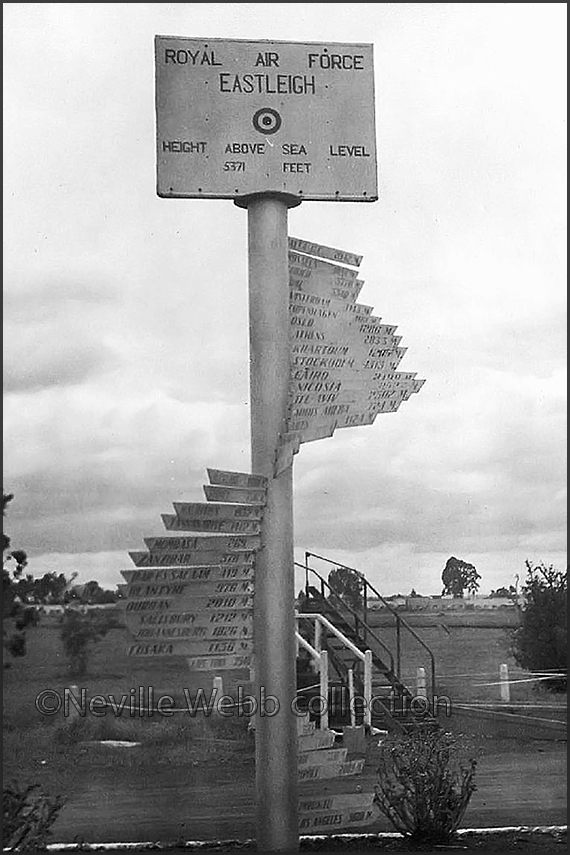
Below are pictures of HP Hastings crash at RAF Eastleigh (Nairobi) in 1961, also pictures of other aircraft on the base at the time.
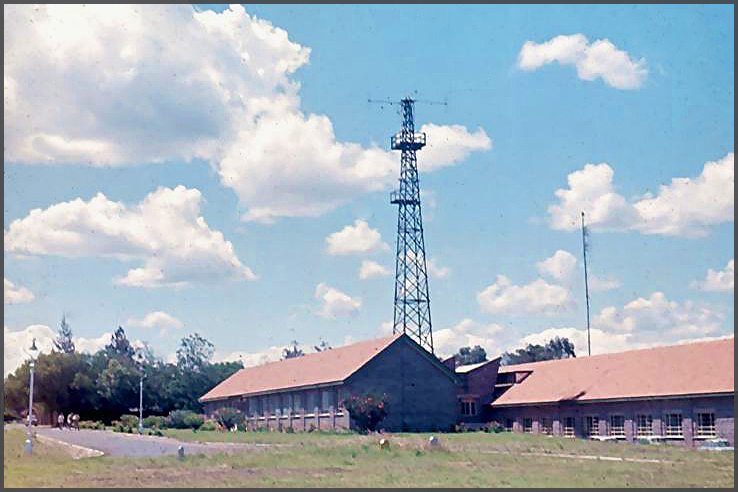
During 1960-61 I was stationed at RAF Eastleigh, Nairobi, and worked in the PXI Section of the Signals Centre. That section provided secure on-line communication links to RAF stations in Aden, Malta, Cyprus, Gan, Singapore and the UK. A very busy section with watch-work hours, two days on and one day off except for the weekend when the section closed on midday Saturday until Monday 8 am.


Signals Centre RAF Eastleigh

BID30 coding unit.
BID30 coding unit

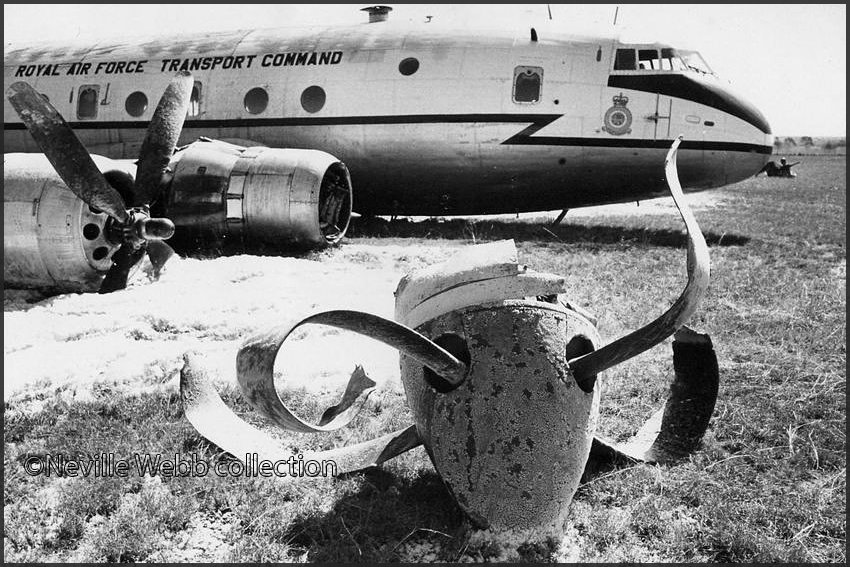
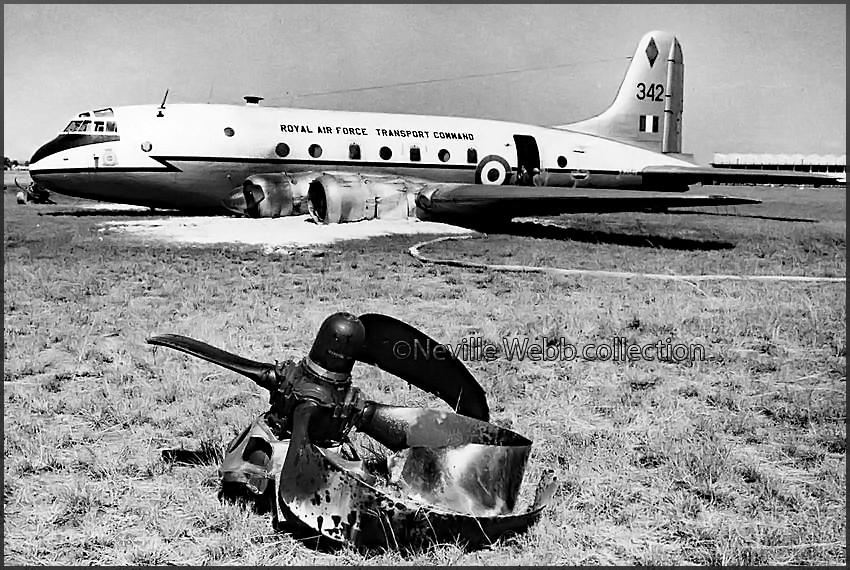
On January of 1961 while off-watch somebody in the barrack room mentioned an aircraft had crashed, so went to see the HP Hastings aircraft that was lying in an open area off the runway. An engine failed on take-off and despite heavy braking there wasn't enough runway remaining to safely stop and the Hastings departed the runway and collapsing its undercarriage. I ordered two photographs of the Hastings (below). Sometime later a few of us walked to where the fuselage lay minus its wings and tail plane and fin. Went inside the fuselage but it was just gutted; should have taken photos but never thought to do so.
Bureau of Aircraft Accidents Archives: 23Jan1961, HP Hastings WJ342:
www.baaa-acro.com/crash/crash-handley-page-hp67-hastings-c2-nairobi
ASN: aviation-safety.net/wikibase

HP Hastings WJ342: credit to RAF base photographer, pictures January 1961.
HP Hastings WJ342 crashed
+
HP Hastings WJ342 crashed

RAF Eastleigh is now Moi Air Base
Wikipedia: Eastleigh Airport (Moi Air Base) is located in the northern part of Eastleigh (Nairobi).
The base was the site of the British Royal Air Force base known as RAF Eastleigh. The dual-use facility was also the main civilian international airport in Nairobi for the period 1943–1958 before the opening of the new airport at Embakasi (since named Jomo Kenyatta Int'll Airport).

Neville: "While at the RAF Eastleigh Signals Centre, from 1960 to 1961, I hadn't the time to visit other sections of the base. However, I did manage to take aircraft photos, including on one occasion during an air display.
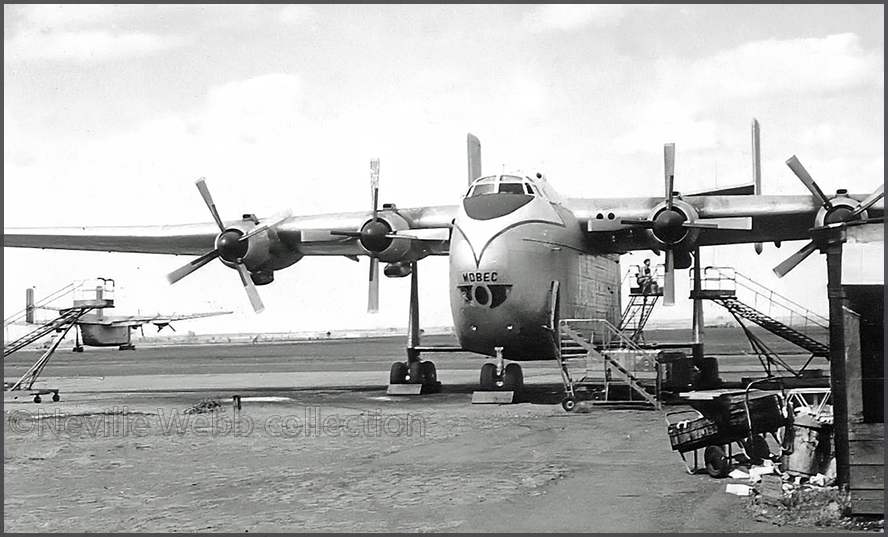
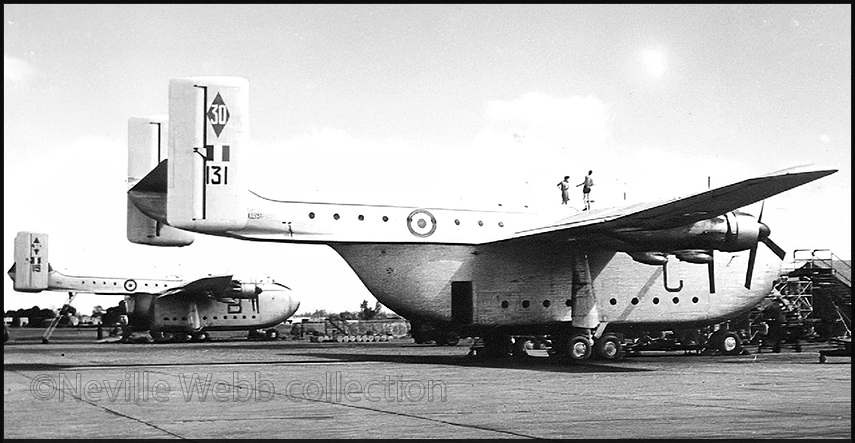
RAF aircraft regularly using Eastleigh included Scottish Aviation Twin Pioneer and Blackburn Beverly.
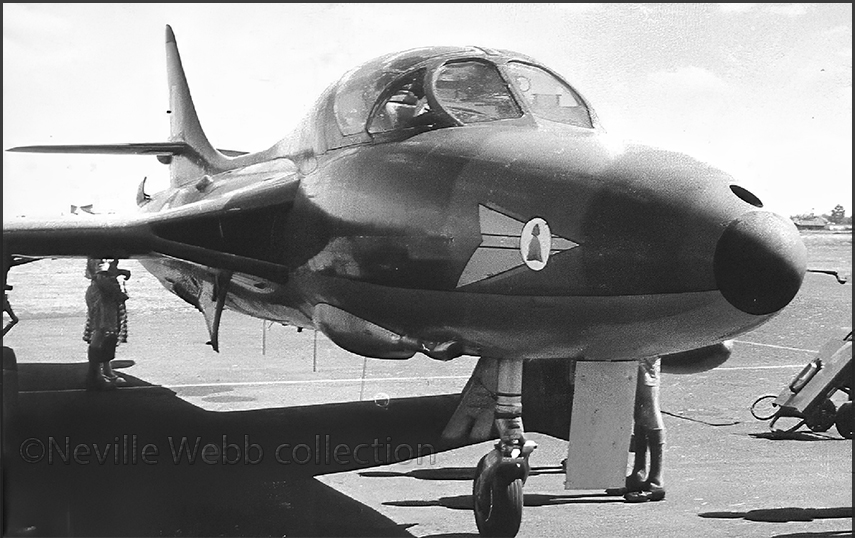
And Hunter fighters operated from the (then new) Embakasi Airport, now named Jomo Kenyatta International Airport, only returning to Eastleigh for maintenance."

RAF Eastleigh history, early 1960s

©Neville Webb collection
Blackburn Beverly: en.wikipedia.org:_Blackburn_Beverley
©Neville Webb collection

RAF Eastleigh
RAF Hawker Hunter

RAF Eastleigh
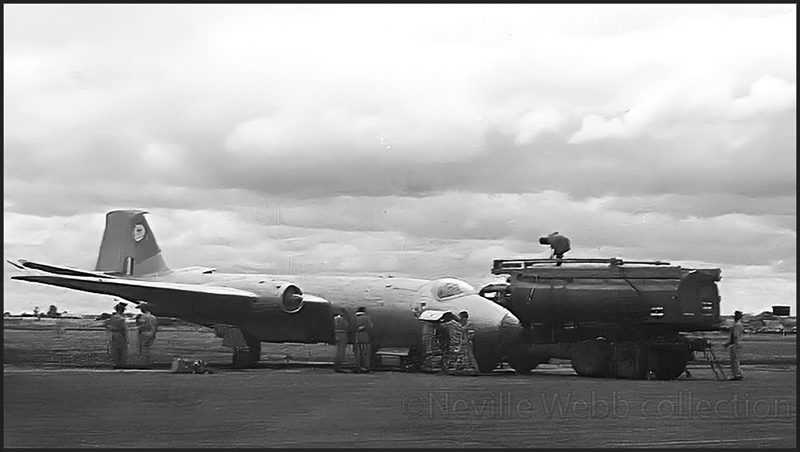
B.A.C. Canberra being serviced refuelled.

RAF Eastleigh and Moi Airbase (maybe closed): www.radfanhunters.co.uk/Eastleigh
Moi Airbase: wikimapia.org/ - /Moi-Air-Base-Kenya-Air-Force-Eastleigh

On Google Maps one can see the outline of what was the RAF Signals Centre. Only the building that was the Administration Section remains. www.google.com/maps/place/Eastleigh,+Nairobi,+Kenya

Neville added: "Perhaps of interest: I arrived at RAF Khormaksar (Aden) in 1960 on board a RAF Transport Command Britannia, via El Adem. A few days later I flew to Kenya as the only (!) passenger on board a Royal Rhodesian Air Force Argonaut... The first memorable sight of Kenya was the snow covered peak(s) of Mount Kenya.
And I departed Kenya in 1961, from Embakasi, on board a Britannia aircraft of British United Airways,
to Stansted, via Tripoli."


Neville in April 2026: "My son R. Webb took photos 2 weeks ago at the restored Departure Lounge at Gander International Airport. I've written information and added links."

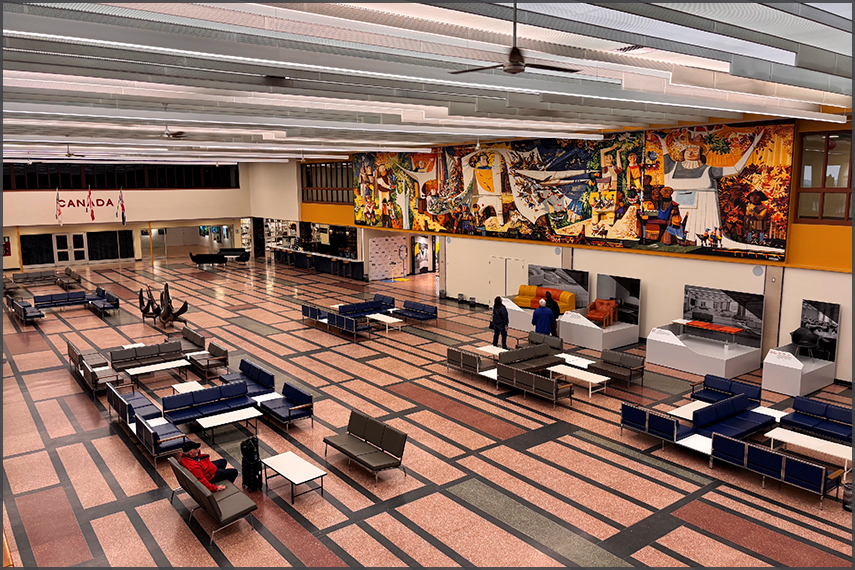
The restored lounge at Gander IAP.
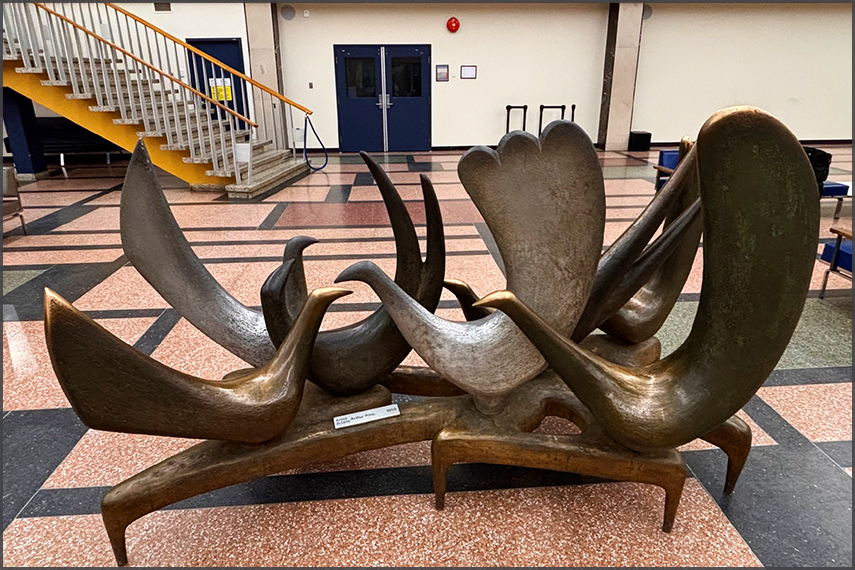
Arthur Price’s sculpture 'Birds of Welcome'.

Departure Lounge Gander International Airport
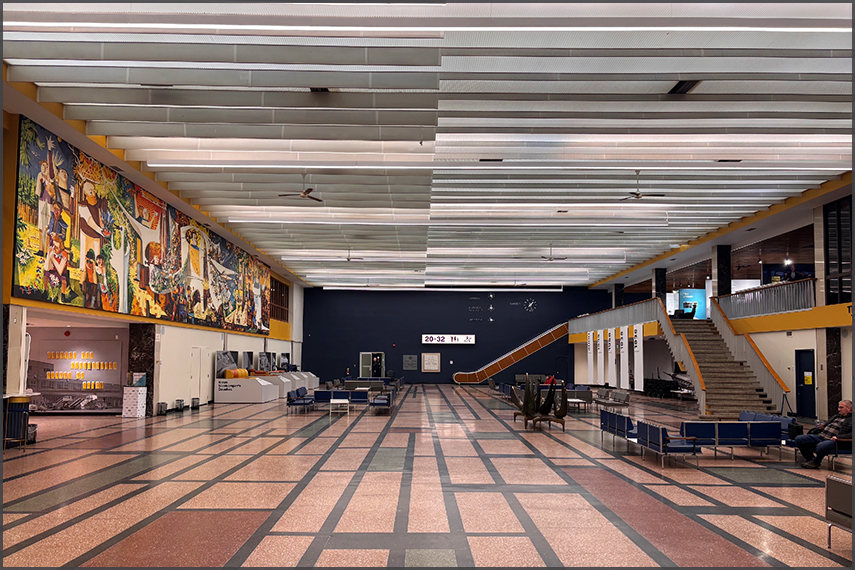
The restored lounge at Gander IAP.
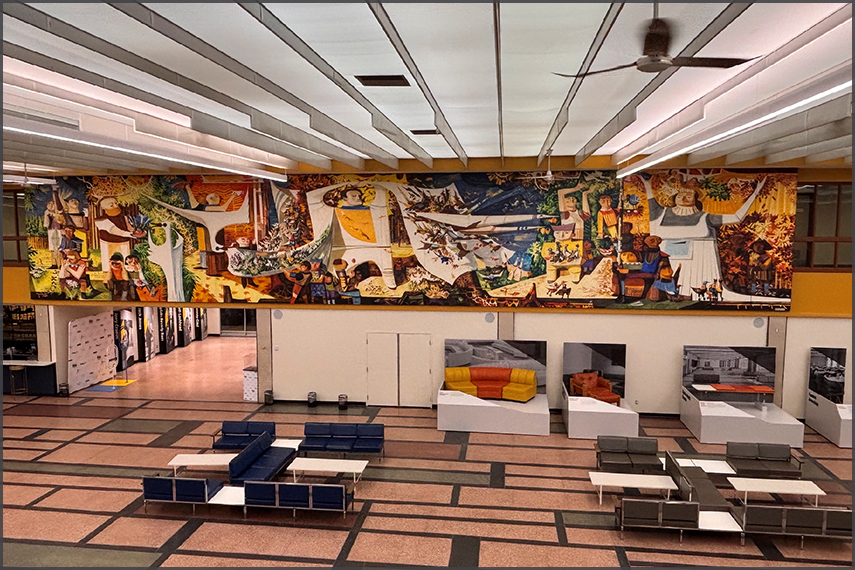
Modern furniture, Mural and terrazzo floors in geometric patterns

The Departure Lounge is now a Registered Heritage Structure. The Lounge includes a viewing area, gallery, boardrooms, mezzanine, and bathrooms.
Features include the terrazzo floors in geometric patterns, an open floor plan with large windows, and artworks like Kenneth Lochhead’s famous avant-garde Mural and Arthur Price’s sculpture 'Birds of Welcome'.
www.ichblog.ca/2026/03/gander-airport-international-lounge

Gander’s global importance as a touch down point faded when jumbo jets from more western points started crossing the Atlantic non-stop in the 1960s.
Air traffic dwindled in Gander, and with it the need for a large airport terminal. Plans to build a smaller, more efficient terminal, unveiled in 2015, put the dazzling departures lounge at risk.
The lounge today is a kind of time capsule, a perfectly preserved moment when air travel was exotic and glamorous. It’s considered the single most important modernist room in Canada!


The restored lounge at Gander IAP.
'Flight and Its Allegories', by Canadian artist Kenneth Lochhead.

National Trust of Canada: Gander International Airport Departures Lounge
Gander Airport officially opened in 1938 and by the 1950s it was one of the busiest international airports in the world.
In June 1959, the Canadian government unveiled an upgraded Gander Int'l Airport as part of a nation-wide airport building program to show the world, through its striking architecture, that Canada was a forward-thinking, cosmopolitan nation.
The International Departures Lounge was the centerpiece of the airport and is considered by design experts to be the single most important modernist room in Canada, incorporates such striking elements as:
[a} a 22-metre mural painted on-site by Kenneth Lochhead,
[b] geometric terrazzo floors, and
[c] cutting-edge furniture by renowned Canadian and international designers like Robin Bush, Jacques Guillon, and Arne Jacobsen.
nationaltrustcanada.ca/ - /gander-international-airport-departures-lounge

The restored lounge at Gander IAP.

Welcome to Newfoundland and Labrador!
Exalted by the NY Times as "perfectly preserved, the terminal is a time capsule from the heady days when travel was exotic, and airports were beacons of the future."
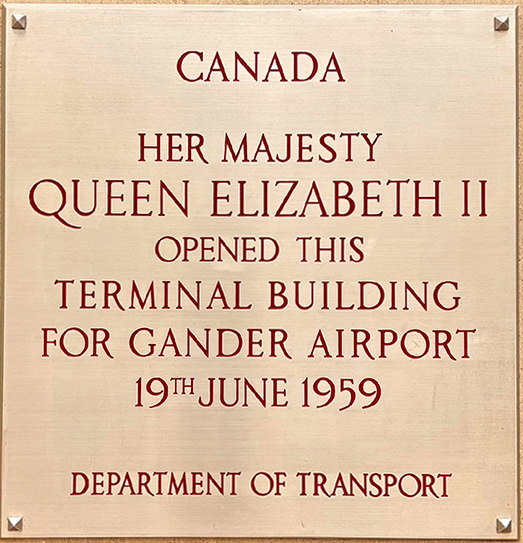
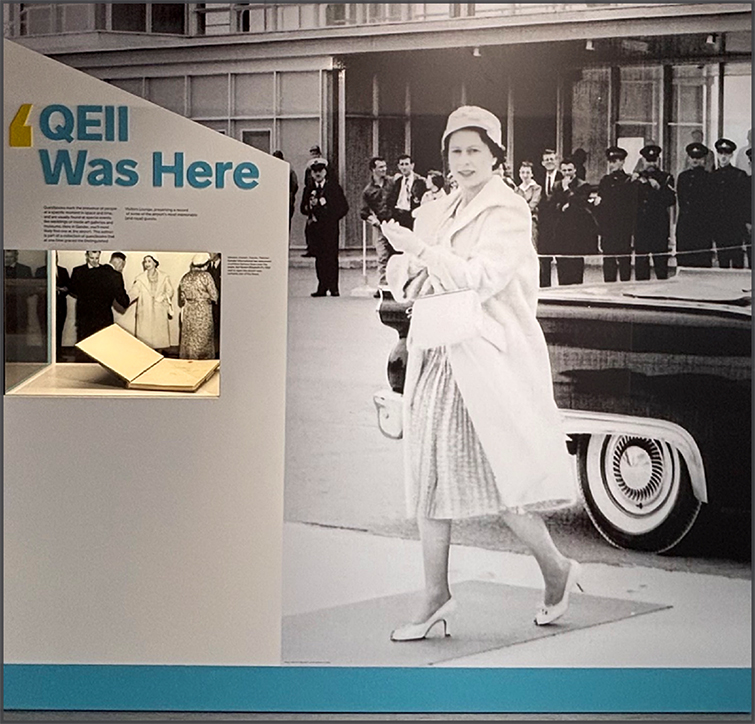
The international lounge was opened with the blessing of QE2 in 1959.
Architects consider it Canada’s most important room. Featuring acclaimed modernist art, furniture and architecture, a theatre and artisanal cocktails.
Exhibits tell the stories of transatlantic triumphs, tobogganing communists, and celebrity encounters.
www.newfoundlandlabrador.com

Opening Plaque, QEII June 1959
The restored lounge at Gander IAP.
Queen Elizabeth II, at Gander International Airport in 1959

Gander International Airport.
Officially opened in 1938, at one time Gander was the largest airport in the world...
Following WWII the airport became a busy refueling stopover for transatlantic air travel in either direction. Flights to and from New York were made by airlines such as BOAC, Pan Am and TWA. Westbound flights arrived from Heathrow, via Shannon, Ireland. By the 1950's the airport was said to be the Crossroads of the World.

In 1953 a new Terminal & Departure Lounge was opened by QEII.
However, passenger figures dropped with the introduction of jet passenger aircraft that had the range to cross the Atlantic without the need for a refuelling stopover at Gander passenger.
Also, upon the increase of costs (such as heating the terminal) it was decided to close the Departure Lounge in the late 1970's.
The story of the Departure Lounge and its reopening to the public in 2022, is given in the links and citations given below.


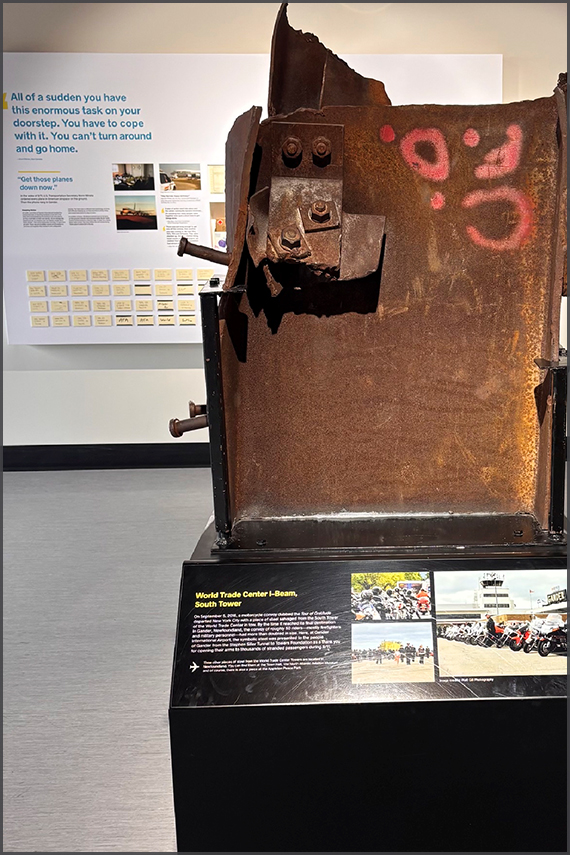
Structural steel from South Tower World Trade Centre (NYC)
The restored lounge at Gander IAP.
9/11 brought chaos and disruption all over Canada

During World War II, Newfoundland was dominion of Britain. Due to its strategic importance, the airport was turned over to the Canadian government for the duration of the war.
Gander became one of the main staging points for the movement of Allied aircraft to Europe. P
ost-war, it was at the crossroads of transatlantic flights and remained an important refueling stop for many years. Everyone from Hollywood movie stars to pop stars to world leaders touched down in Gander.

On the morning of September 11, 2001, as the Twin Towers were collapsing in New York City, 38 jet planes were re-routed to the modest airport in Gander, Newfoundland.
More than 7.000 passengers found themselves stuck in a town of 13.000 for up to five days, with only 500 hotel rooms available in the vicinity...
The story of how the community came together to welcome and care for all these unexpected visitors, at such a tragic time, is today the subject of a hit Broadway musical, Come From Away.
Volunteers made lunches, elementary schools were turned into dormitories, and the hockey rink became a walk-in refrigerator.
The "plane people", as they were called, hailed from 95 (!) countries, and they were welcomed with open arms by the people of Gander and nearby communities.

The Mural Gander International Airport Departure Lounge
The mural was designed by Kenneth Lochhead, who the National Gallery of Canada says was at the forefront of Canada's modern art movement.
Because traffic through the lounge has been sporadic since international flights began bypassing Gander, there's been a question of what value the art within it has, and if its value has been diminished...?
"The value of this artwork is that it acted as a greeting to everyone, from celebrities to the average person, to people fleeing from the Eastern Bloc to people during 9-11".
Citation: www.cbc.ca/news/canada/newfoundland-labrador/gander-airport-mural-

Closure of the Lounge to Mid Century Tourist Attraction:
The airport’s 1959 international departure lounge, opened by the Queen of England, has sat idle for decades...
The airport is a strategic diversion point, but planes fly long distances now without the stop. And the old departure lounge was closed off in the late 1970s.
Yet the airport took [has taken steps] to preserve the departure lounge furnished in bright orange and yellow "by famous designers such as Charles and Ray Eames, Robin Bush, Jacques Guillon, and Arne Jacobsen."
It features a striking mural by Canadian artist Kenneth Lochhead, floor tiles that are reminiscent of Piet Mondrian, and swivel chairs in the ladies washroom. And the pay phones!
Note: Following the lounge getting a $1.5 million restoration and is open for free to the public.
Citation: viewfromthewing.com/gander-airport-international-departure-lounge/

VOCM News: Restored Gander Airport Lounge to Reopen.
The international departures lounge at Gander Int'l Airport was opened by Queen Elizabeth II in 1959, and features a 22-foot mural 'Flight and Its Allegories', by Canadian artist Kenneth Lochhead.
The future of the famous landmark, which saw politicians and dignitaries from around the world, was placed in jeopardy when the Gander Int'll Airport Authority was considering what to do with the space in light of reduced airport traffic...
The unique space has not changed in the last 60 years and retains its original glamour and style.
With the help of the provincial and federal governments, the lounge in recent years restored and officially reopened to the public, on June 29th, 2022.
VOCM.com/2022/06/15/gander-airport-lounge/


Gander Fly-in Visits, more aviatio memories by Neville

Gander International Airport (ICAO:CYQX - IATA: YQX) was said to be the 'Crossroads of the World'.
I was fortunate to fly twice to Gander with friend Ron in Piper Cherokee CF-AJY, firstly in the late 1980s.
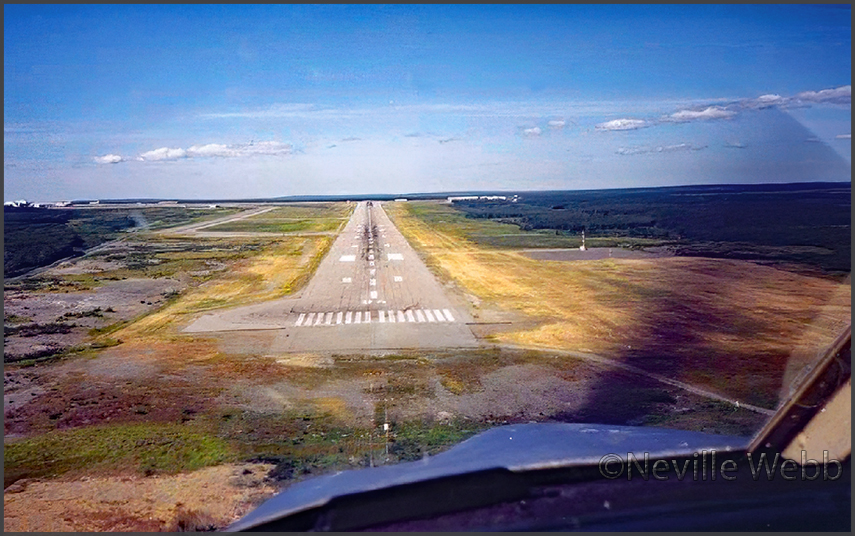
After touch down on the long 03-21 ten-thousand foot length runway we turned left at the first taxiway and taxied to and past the airport passenger terminal to our parking place.
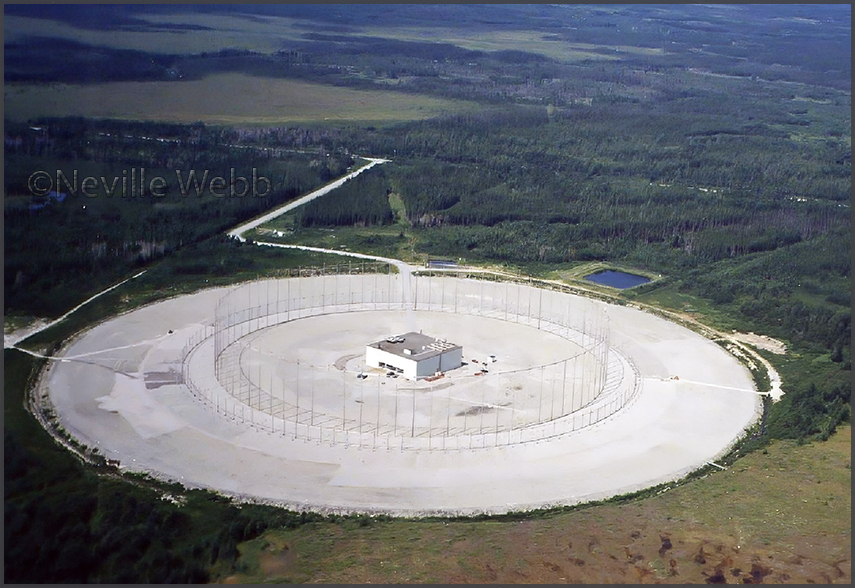
The 2nd time we flew to Gander was in the 1990s passing over the south end of Gander Lake, then a downwind leg distant from and parallel to 03-21. Passed over the large circular area of the covert radio intelligence gathering site whose origins go back to WWII.
This site acquired the local nickname of the 'Turkey Farm' because the fence-like circular ariel array surrounding a central building.
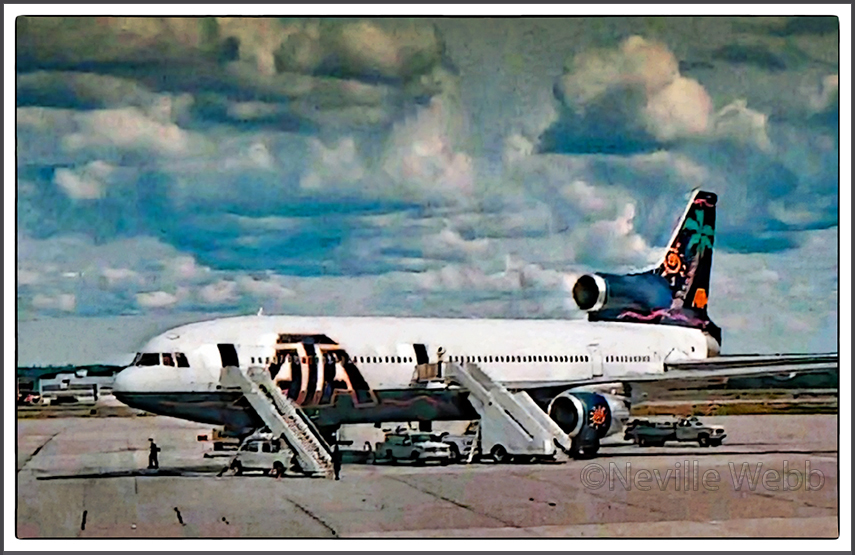
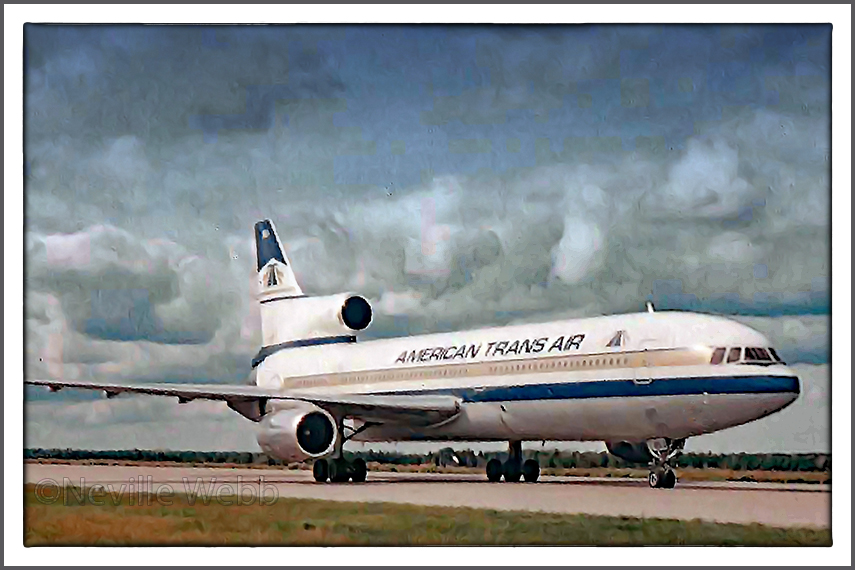
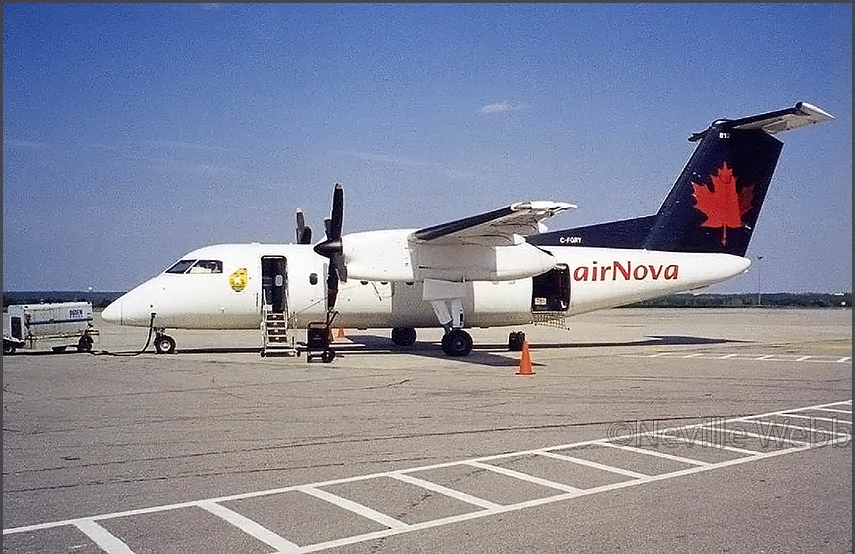
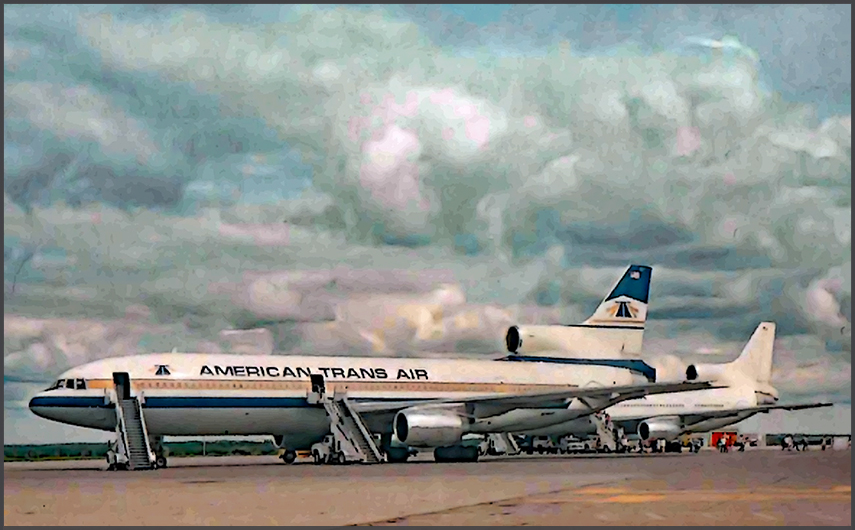
After that made the required turns to land on runaway 21-03 We taxied to park our parking place passing by large passenger aircraft including several American Trans Air (ATA) Lockheed L-1011 TriStar, an Air Nova Dash 8 and a Corning Inc. Dassault Falcon 2000 business jet.
To one side were two military Hercules and an Antonov An-26 parked on what possibly was part of the former 60-27 runway. We were able to walk along the apron to photo some of these aircraft!

Radio Intelligence Gathering Site + Gander Top Secret Military Operation >>>Pix further down.

ATA Lockheed TriStar Images + ATA and Gander (It was said Gander became a 'second home' to ATA crews in transit).
Citation: "American Trans Air, better known as ATA Airlines, was an American low-cost airline that offered scheduled flights and charters. Headquartered in Indianapolis, Indiana. ATA also began a twice weekly charter service from Orlando to both London Gatwick Airport and Manchester in the UK.
All these services operated via Gander in eastern Canada where the aircraft would refuel.
... Services to the UK ceased in 2002 when Travel City switched to another airline, Air Atlanta Europe".

What Happened to ATA
Citation: "ATA Airlines also began flying from Orlando International Airport (MCO) to London Gatwick Airport and Manchester Airport (MAN) twice-weekly.
Most seats were reserved for a United Kingdom travel agency called 'Travel City Direct', a tour operator specializing in fly-drive vacations.
All ATA Airlines flights between Florida and the United Kingdom stopped in Gander, Newfoundland, for refueling."
See photos further down <<<

Airlines Remembered: ATA www.ruudleeuw.com/rem-am-transair

Air Nova  1994 - 2001 - en.wikipedia.org:_Air_Nova
Gander Fly-In, aviation memories by Neville WebbGander runway 03-21 10,200 feet length
Gander Fly-In, aviation memories by Neville Webb
CAF Communications Research Site - Gander

Gander Fly-In, aviation memories by Neville Webb
American Trans Air (ATA) Lockheed TriStar

Gander Fly-In, aviation memories by Neville Webb
ATA Lockheed Tri Star, celebrating southern destinations!

Gander Fly-In, aviation memories by Neville Webb
Lockheed Tri Star of American Trans Air, taxiing at Gander IAP.
Neville:"...a lovely summer day with air temp 32°C at Gander. Took this photo of the taxiing Tristar
by walking out to near runway."

Gander Fly-In, aviation memories by Neville Webb
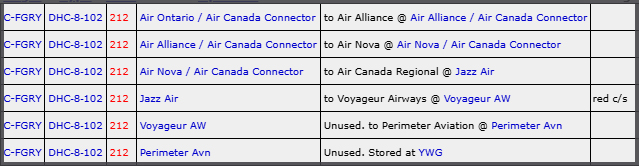
Air Nova Dash 8, C-FGRY
De Havilland Dash 8 - en.wikipedia.org:_De_Havilland_Canada_Dash_8
+
ATDB.aero today (May 2026) on C-FGRY c/n 212 (now stored)
Dash 8 C-FGRY

Gander Fly-In, aviation memories by Neville Webb
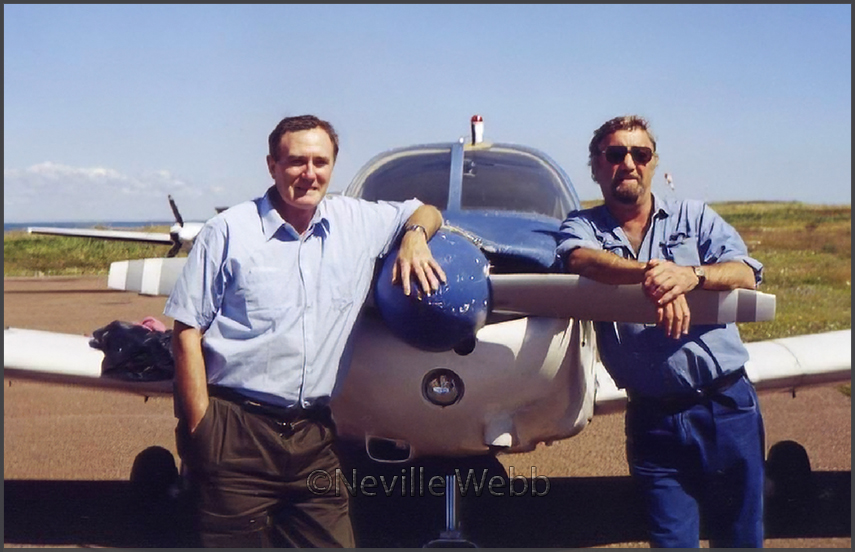
Cherokee CF-AJY (Neville on the left, Ron on the right)

Neville:".. that visit remembered for two other reasons: Ron in RH seat forgot to close door so had to ask for
‘go around’ for a ‘full-stop’ landing on 21-03Ooops.
Then, when Ron flew low and slow over his former home, the community of Gambo, (south of Gander) the engine oil temperature went into the red! Very slowly crept to higher, cooler altitude while I was thinking about possibly landing on Trans Canada highway! Oil temperature slowly decreased and so returned to YYT!

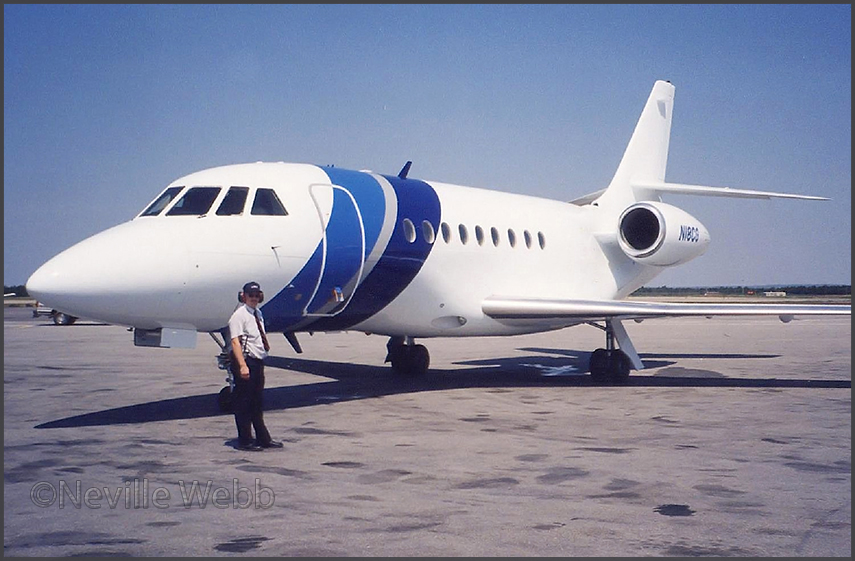
Corning Inc. Dassault Falcon 2000, N18CG [en.wikipedia.org] Gander Fly-In, aviation memories by Neville Webb Citation:The Dassault Falcon 2000 is a business jet produced in France by Dassault Aviation, a member of its Falcon business jet line. Developed from the Falcon 900 trijet, the smaller twinjet has less range.
 

Neville sent me this Aviation History report by him in May2026.
One fog day went to the Mount Pearl Museum, formerly a Royal Navy WWI Top Secret Radio Station, one of eleven stations around the world listening to German radio transmissions. Only once before in 50 years I visited...
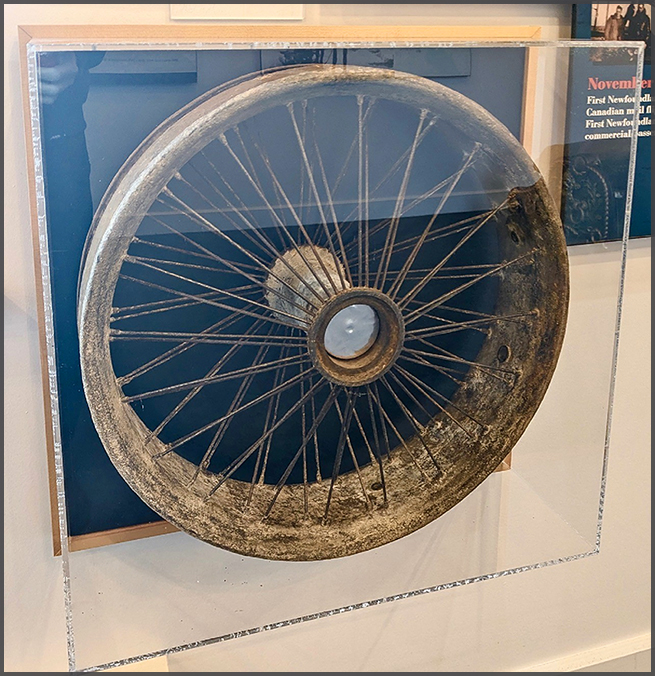
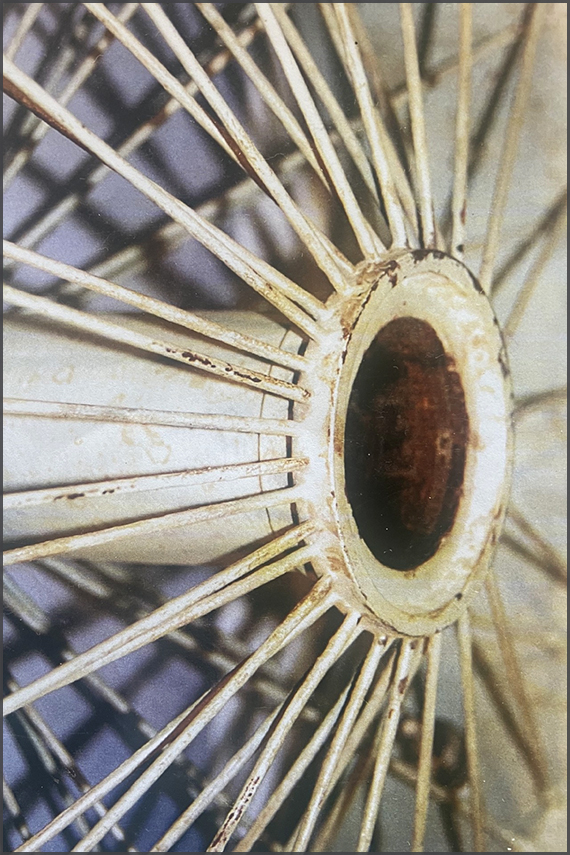
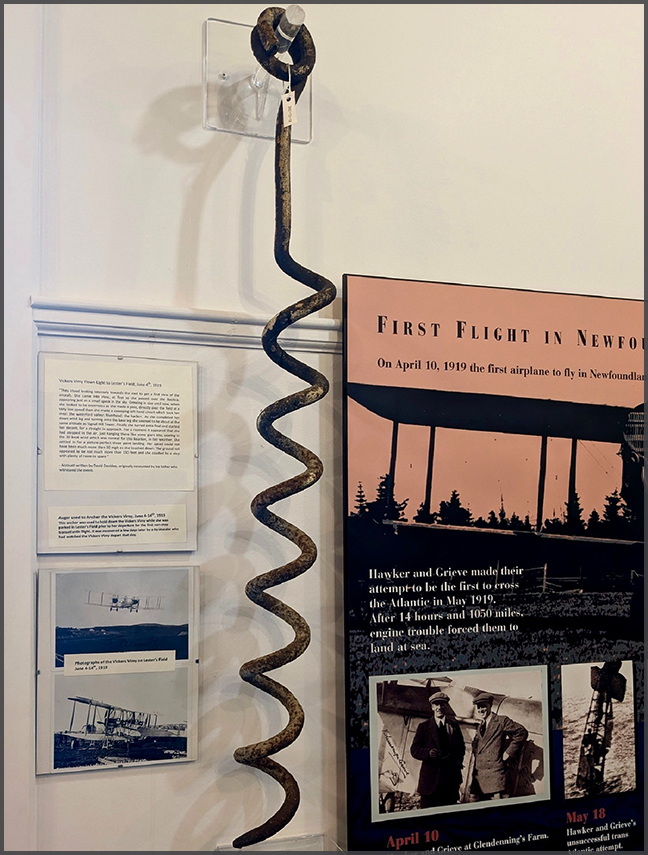
On display is one main undercarriage wheel from the Hawker and Grieve attempted TransAtlantic flight.
The undercarriage was dropped at sea to save weight and was later recovered by a fisherman.
To follow up this story visited The Rooms Provincial Museum and was able to photograph each of two photos
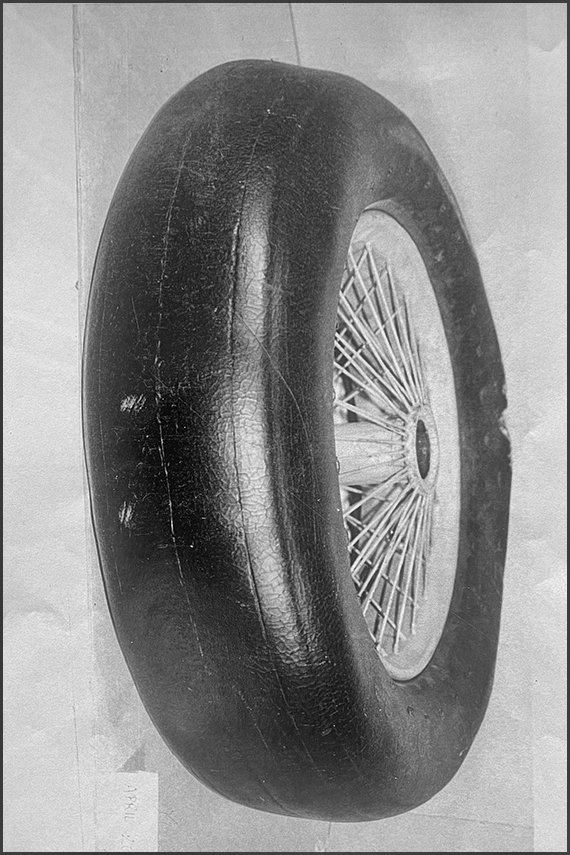
of the other wheel with its Palmer Aero Tyre. The actual wheel is in storage somewhere when not on display.
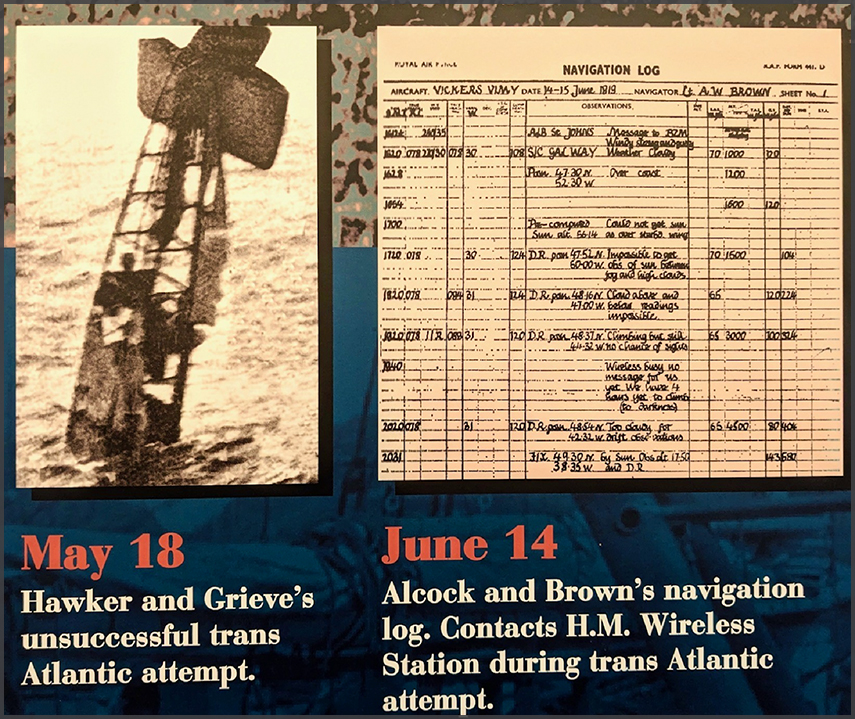
Attempted Transatlantic Flight, Sunday 18May1919, by Hawker and Grieve

Secret Royal Navy WWI Radio Station and Attempted Trans Atlantic Flight Mount Pearl Admiralty Museum,NFL
Youtube.com/@mike555-v5x
Citation: This historic building was originally constructed in 1915 by the Marconi Telegraph Co. during the First World War as the top-secret H.M. Wireless Station for the British Royal Navy.
This station, now the last standing of the 11 identical stations around the world, was built to intercept secret German naval transmissions, track icebergs, and ships in distress.
Admiralty Museum:
historicplacesdays.ca/places/admiralty-house-communications-museum-and-archive/
Admiralty House, Mount Pearl, NL
en.wikipedia.org:_Admiralty_House,_Mount_Pearl
Citation: In 1914, the site was selected by the British Admiralty for a First World War communications post. It was constructed in 1915 by the Marconi Telegraph Company to serve the Royal Navy. It was built to intercept secret German naval transmissions, track icebergs, and track ships in distress:
The Admiralty designated H.M. Wireless Station at Mount Pearl as its North Atlantic Intelligence Centre. Members of the Marconi Company were recruited in to the British Navy and sent to work in the wireless station under the command of Officer Lieutenant G.L.J. Wolley. In comparison to other wireless stations in Newfoundland during that time, the H.M. Wireless station was among the most powerful, employing state-of-the-art equipment that allowed transmission and reception of signals over 1000 miles away. The station was guarded by members of the Newfoundland Royal Naval Reserve.

Wonders of World Aviation: Harry Hawker a Spectacular Record Breaker
wondersofworldaviation.com/hawker
Citation: When the war was over, Hawker soon returned to spectacular flying, and this brings us to his disastrous attempt to fly the North Atlantic. This flight, failure though it was, takes its place in history because it was the first attempt to cross the North Atlantic in an aeroplane.
Aviators were eager to be the first over the North Atlantic, and almost immediately after the Armistice, preparations were made to build or convert machines for the crossing. The idea was formed into a definite competition by the £10,000 prize offered by Lord Northcliffe for the first aviators to accomplish this feat.

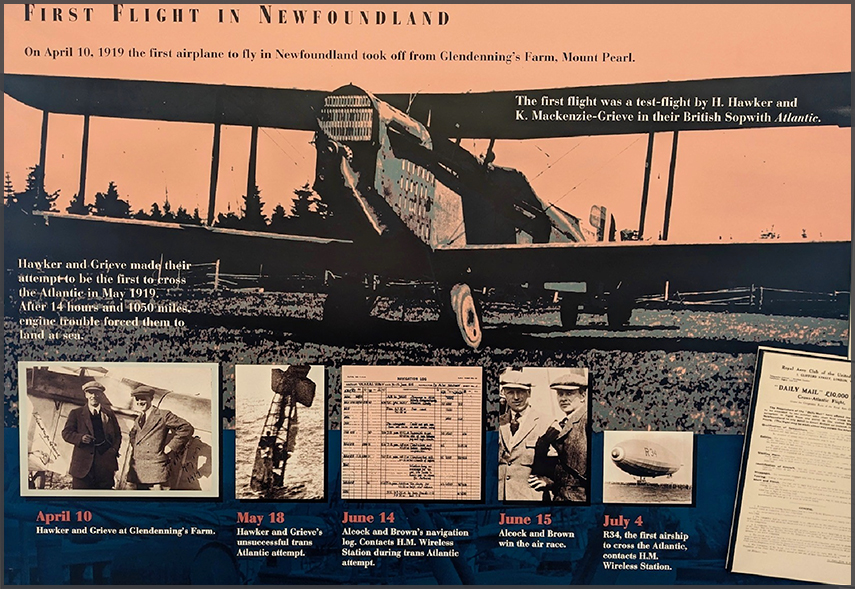
"On April 10, 1919 the first airpane to fly in NFL took off from Geldenning's Farm, Mount Pearl"
Hawker and Grieve Flight Information and Ditching

Stake used too Tie-down the Sopwith aircraft, Mount Pearl.
Stake used too Tie-down the Sopwith aircraft, @Mount Pearl.

Hawker and Grieve Attempted Trans Atlantic Flight
Attempted Transatlantic Flight, Sunday 18 May 1919
Hawker and Grieve set off from Mount Pearl, near St John’s, in Newfoundland, Canada at 6.48 pm on Sunday 18 May in Hawker’s Sopwith aircraft and were expected to reach the Irish coast at around 3 pm the following afternoon but never arrived.
Attempt at first transatlantic flight:
www.rte.ie/centuryireland/ - /attempted-transatlantic-flights-end-in-failure-and-mystery`

Photo maybe of Hawker and Griever after ditching, OR salvage crew recovering aircraft.
Photo maybe of Hawker and Grieve after ditching, OR... salvage crew recovering the aircraft.
Right: Navigation Log - HM Wireless Station, Mount Pearl Admiralty Station.

Aviation Safety Network: aviation-safety.net/wikibase/
Citation: The race to fly non-stop across the Atlantic continued at Newfoundland.
Two unsuccessful attempts were made on 18 May 1919.
Harry George Hawker and Kenneth Mackenzie Grieve departed from a field in Mount Pearl, but an engine of the "..Sopwith failure forced them to land in the Atlantic Ocean 14 hours and 1.770 kilometres later.
They were rescued by a Danish freighter.
Images: ca.images.search.yahoo.com/search/images

Ditching and Aircraft Recovery
Wikipedia: en.wikipedia.org:_Harry_Hawker
The Atlantic was found afloat and recovered by the US steamer Lake Charleville. The wheels from the undercarriage, jettisoned soon after takeoff were later recovered by local fishermen and later donated to the Rooms Provincial Museum in St John's.
One wheel is currently on display at Admiralty House Communications Museum in Mount Pearl.

Kingston Aviation:
Citation: Including Images: www.kingstonaviation.org/from-the-surrey-comet/1919-atlantic-crossing-attempt/
Thus the Surrey Comet Mid-Weekly, in its editorial of Wednesday 21 May 1919, reported the start of the flight.
But the flight had been expected to take about 24 hours so, it being 3 days later already, the leader continued that
" … he dropped his undercarriage and … vanished into the blue. Since then not a word has been heard or a trace seen of the airmen or their machine."
"... it is notable that the reports were not of the aeroplane problems that forced the ditching but of the airmen and the welcome home they were afforded.
This was a nation used to cheering British explorers returning from the ends of the earth; there were no expectations of hearing details or seeing newsreels of the event. The men represented the event."

Palmer Cord Aero Tyre 900 200: The Rooms Provincial Museum, St. John's, NFL.
One of the two main wheels from the undercarriage jettisoned by Hawker and Grieve, complete with tire, is held but not presently on display, by The Rooms Museum St. John's NL.
During a visit the museum on 14May2026 I (Neville) was provided with catalog data and two photos of the wheel with tire.
Catalog Number 986.171
The partner to this wheel, without tire, is displayed at @Mount Pearl Admiralty Museum, NFL.

London Remembers:
Citation: From Car History: www.londonremembers.com/ - /palmer-tyre-company
In June 1892 John F. Palmer (American) obtained two US patents for a 'thread-fabric' bicycle pneumatic tire.
Shortly afterwards he moved to England; registering the Palmer Tire Company in 1895 and he opened a tire production plant at a factory owned by the India Rubber Company in Silvertown.
www.londonremembers.com/ - /palmer-tyre-company
Graces Guide To British Industrial History:
Palmer Tyre
: Palmer Tyre - Graces Guide
Citation: Palmer Cord Tyres was founded in 1895, made tires for many vehicles up until roughly WW2, by that time they were specializing in aircraft tires, wheels and brakes.
The company had become a subsidiary of Goodrich rubber in 1933. In 1957 the company name was changed to Palmer Aero Products.
www.gracesguide.co.uk/Palmer_Tyre


Undercarriage Main Wheel without Tire @Mount Pearl Admiralty Museum.
Partner wheel c/w tire held by Rooms Provincial Museum.

Hawker_Grieve-Palmer_Aero_Tyre
Mainwheel Spokes - Photo of Rooms Museum Photo.


Jettisoned Mainwheel c/w Palmer Cord Aero Tyre 900 200. Photo of Rooms Museum Photo.


In Sep.2026 Neville shared these photos, dating from RAF Hawkinge (1957; the Spitfire photo is from 1952).
Text by Neville Webb.

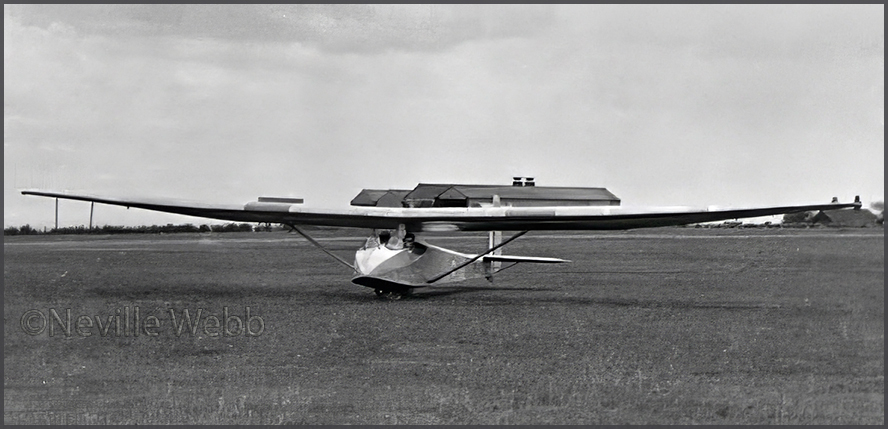
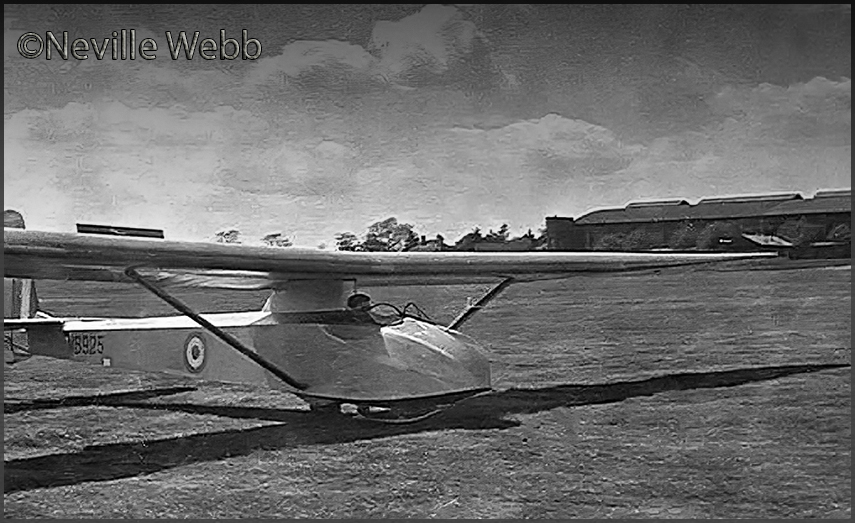
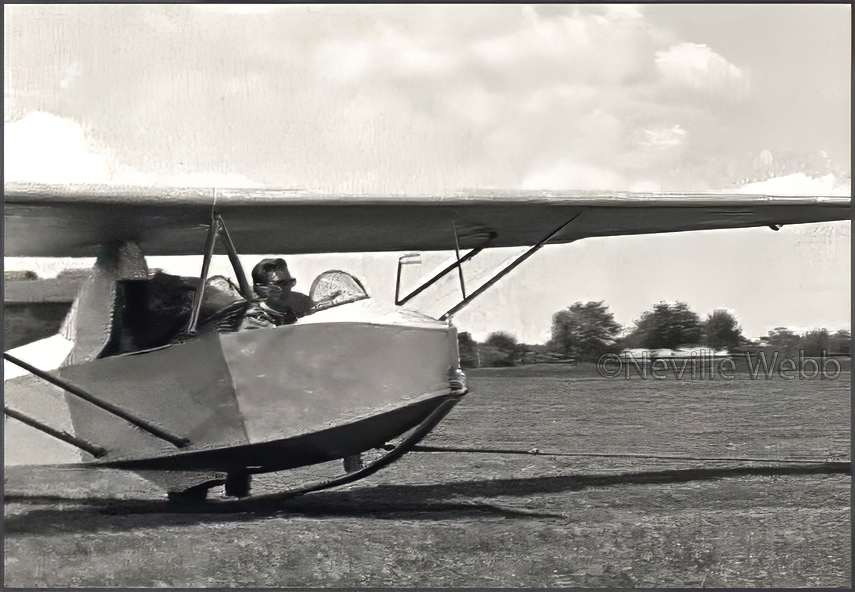
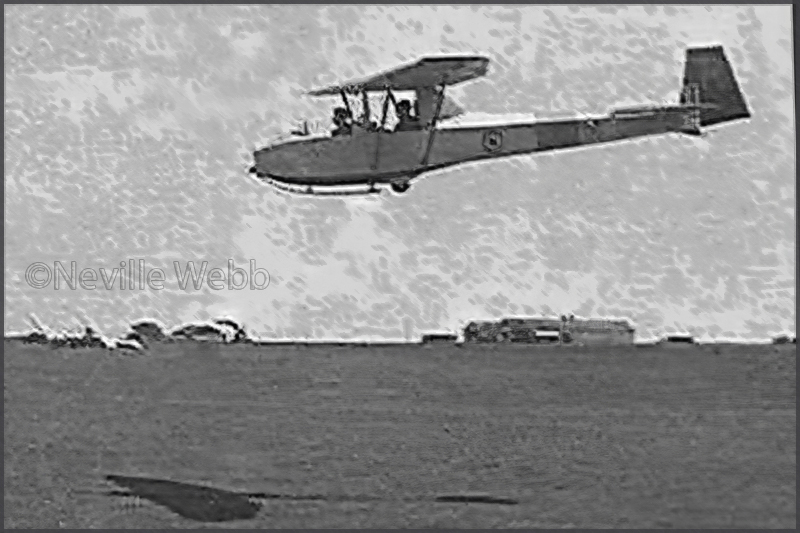
Air cadets Home Command Gliding Centre RAF (part of RAF Home Command), where many Air Cadets first learned to fly in Slingsby Mk III and Slingsby Sedbergh TX Mk.1 gliders.
The Home Command Gliding Centre was ancillary to the training unit, the reason being that the grass airfield made it ideal for ATC Cadets to learn to fly sail planes.
The purpose of the introductory Gliding Scheme was to give ATC cadets basic flying experience.

RAF Hawkinge 1957 (C) Neville Webb

RAF Hawkinge
In the summer of 1956, as a Sergeant in the Air Training Corps (ATC), I had the opportunity to visit RAF Hawkinge for a one week of Gliding instruction to solo flight level.
Other cadets on the course were from ATC squadrons in the South Wales area. Looking at past aerial photos of the airfield it seems largely built over with housing.
However, I remember walking along Aerodrome Road, particularly when returning after going out for a few ales and to a fish and chip shop located on Canterbury Road.

RAF Hawkinge 1957 (C) Neville Webb

RAF Hawkinge 1957 (C) Neville Webb

RAF Hawkinge Gliding Course 1956.
The gliding course consisted of a couple of introductory dual flights in the Sedbergh glider, being expected try a landing  on the second flight!
This was followed by 30-35 dual flights in the Slingsby Mk III before being sent solo. To gain the Gliding Association badge one had to do 3 consecutive solo flights. Gliders were launched to height by powered winches located on the far side of the airfield.
One clear memory was the view at the top of each launch of the curving coastline towards the distant Thames estuary, the same view seen by pilots during the Battle of Britain!
I don't remember any detailed instruction on the principles of flight. During dual flights don't remember being given any instruction about what to do if the launch cable parted...
It was simply a case of 30 launches then solo!
I did experiment on one solo flight by throwing the control column from side to side with no resulting roll effect.

Unfortunately at that time there was no opportunity for ATC cadets to reach further badge levels which would include soaring flight.
I had to wait until the summer of 1959 before further gliding experience at the RAE Farnborough, where I experienced a number of cable breakages.


RAF Hawkinge 1957 (C) Neville Webb

RAF Hawkinge 1957 (C) Neville Webb

Wings for Victory Week 1943.
Aged five years old during a brief wartime visit to Weston-Super-Mare with my parents, we rounded a corner to unexpectedly see a green fuselage of Heinkel He 111H-6 loaded on a 'Queen Mary' type trailer...
A man gave some description but being young I didn't understand the word 'fuselage'.
This aircraft was one of other enemy aircraft on display around Britain.
My 2nd view of a He.III was while waiting for a flight at Winnipeg Airport in about 1988. While looking out along the airport a B-17 suddenly appeared, moving slowly along a taxiway; a Boeing B-17 with a blue painted tailfin.
The B-17 was followed closely by a He.III, actually a CASA 22.lll operated by the CAF with it's Ghost Squadron airshow, readily distinguished by its RR Merlin Engines. This aircraft was destroyed in fatal crash in Cheyenne, Wyoming, in 2003. The B17 was likely 'Serendipity' B17G-85-DL, operated by the CAF.

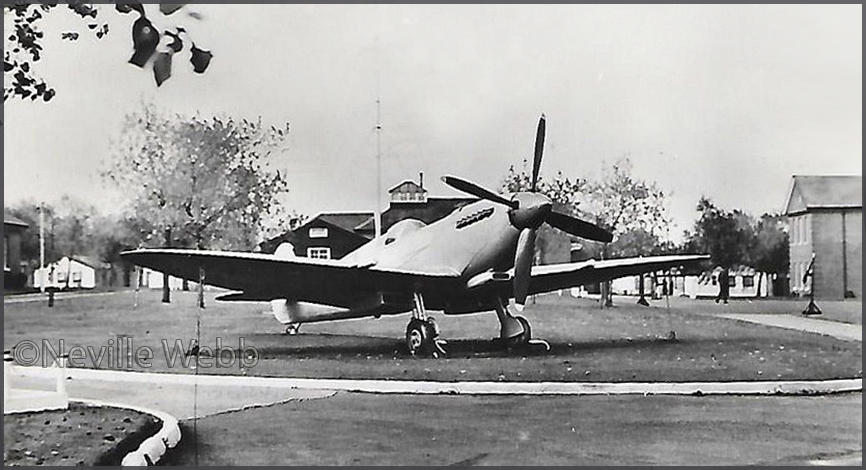
RAF Hawkinge 1952 (C) Neville Webb
Neville: "Outside our barrack was a silver painted Gate Guardian Spitfire Mk. IX, Serial No. MK356, which stood at the Main Gates of RAF Hawkinge until RAF Hawkinge closed in December 1961."

RAF Hawkinge History>>> The history of the airfield goes back to WWI and importantly for the role it played in
WW2, during the Battle of Britain. Historical resources and writings describe the story of RAF Hawkinge in greater detail than I can. Today the airfield and remaining buildings are home to the Kent Battle of Britain Trust.
1. https://www.abct.org.uk/airfields/hawkinge-folkestone/
2. https://en.wikipedia.org:_RAF_Hawkinge


PAGE ONE | PAGE TWO


Back to Top

Lastest update: 01-Okt-2026


To email me, click on the image and write the correct adress as given below
(replace -AT- by the @ symbol)
.

Sorry for the inconvenience, but this is because spam has increasingly become a problem.