 Photos © Ruud Leeuw
Photos © Ruud Leeuw
Our very first visit to India... At the airport of New Delhi we were met by a chauffeur and he drove us through Rajasthan. After visits to Jaipur, Pushkar, Udaipur and Jodhpur, we headed for Jaisalmer in the far western Thar Desert of Rajasthan. It was the second stop where we would stay two nights instead of one. Click on the thumbnail images to view a larger image |
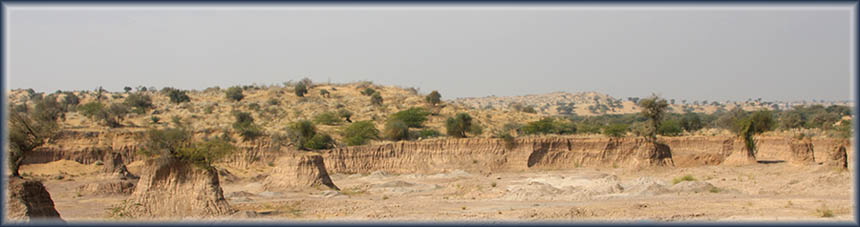 On our way to Jaisalmer from Jodhpur. The surrounding desolate landscape evidences a stark, austere beauty. Villages become rare as we come closer to our most westerly point of this vacation. |
 One of the few villages en route to Jaisalmer. |
 |
 |
|
Jaisalmer is almost entirely a sandy waste, forming a part of the great Indian desert. The general aspect of the area is that of an interminable sea of sandhills, of all shapes and sizes, some rising to a height of 150 ft. Those in the west are covered with log bushes, those in the east with tufts of long grass. Water is scarce, and generally brackish; the average depth of the wells is said to be about 250 ft. There are no perennial streams, and only one small river, the Kakni, which, after flowing a distance of 28 m., spreads over a large surface of flat ground, and forms a lake orjhil called the Bhuj-Jhil. The climate is dry and healthy. Tourism is a major industry in Jaisalmer. The Government of India initiated departmental exploration for oil in 1955-56 in the Jaisalmer area. Oil India Limited's discovered natural gas in 1988 in the Jaisalmer basin. [en.wikipedia.org] |
We arrived at our destination: Jaisalmer's Nachana Haveli. Upon check-in and while unpacking our baggage, we did our usual routine and found several items not in place.
 A visit to the frontdesk with a request to supply the missing bathplug and bring an additional quantity of toiletpaper, he would send a helpful housekeeper to our room with the required items. Who would benefit of a grateful tip... No doubt this routine was repeated with all the guests. At first I was irritated by this inefficiency and inconvenience, but after a while it all made sense. The Indian way. |
 The inner courtyard of the Nachana Haveli. |
 The large rooftop over Nachana Haveli offers a view of the old town as well as the dominating fort. |
 Looking into the streets from our rooftop restaurant, and into another rooftop restaurant! |
|
 |
 Relaxing on Nachana Haveli's rooftop. We ordered tea from the restaurant. Unfortunately there were only two reclining chairs and no other comfortable seating arrangements, quite perplexing! Perhaps because the Indians are not aware of our love for the sun, they themselves would rather seek the shade. Quite invisible here, not recorded in any of these photographs, are the fighter jets screaming overhead all day, performing high alert patrols along the India - Pakistan border. The tension between these countries was easily felt, but at no time did I feel uncomfortable with the relative short distance of 160 kms to that border. While tension between these two countries have always existed, recent (2008) Mumbai terrorist attacks (more than 10 coordinated shooting and bombing attacks across Mubai's financial capital and largest city) were on everybody's mind. The attacks, which drew widespread condemnation across the world, began on 26 November 2008 and lasted until 29 November, killing at least 173 people and wounding at least 308. [Wikipedia] |
 The entrance into Nachana Haveli's outer courtyard from the street.
 Note the intricate carvings and decorations. And again I found that cashing rupees at the nearby ATM cash machine with my Visa card remained impossible. Sofar the only place my Visa card had worked was upon arrival at Delhi's Int'l Airport. Fortunately my 'Maestro' card delivered the required cash without any problem. Only at the next stop, Jaipur, would my Visa card become useful again in this respect. |
|
 Here we were to stay 2 nights again. Since we had arrived here at 16:00 we were soon satisfied with our initial reconnaisance and souvenirs so we returned to the Nachana Haveli with a supply of soft drinks and chocolat biscuits. Our decorative hotel and its Saffron Restaurant were worthy of closer investigation too and we would leave the rest of Jaisalmer for the morrow! |
 What are you looking at! |
 A domestic scene. |
|
Jaisalmer is also known for their fine leather messenger bags, made from wild camels native to the area. This camel is as yet useful for other purposes, pulling tourists through town and perhaps the sandy desert. The morning after our arrival we had a guide to our disposal, for a guided city walk. "BM" first brought us over to a little artificial lake, created for water storage but also for the Maharadja to enjoy worship and picnics! |
 On our way to the lake we passed these young 'musicians' who were performing an enthusiastic "Frère Jacques"
|
| Musicians and dancers are a major cultural export of Jaisalmer to the rest of the world, Manganyar musicians played the world over since decades, and Queen Harish, the dancing whirling desert drag queen, certainly the most talented dancer from Rajasthan, is touring the world extensively and features in international movies. |
 |
 |
 |
|
A musician at Gadi Gadi Sagar Lake. This artificial lake is an important tourist attraction in Jaisalmer. Its charm lies in the fact that it was the only source of water for the Jaisalmer city in the old days. A new reservoir has been built further away from the city. A manmade reservoir, the Gadi Sagar Lake was constructed by Raja Rawal Jaisal, the first ruler of Jaisalmer. In the later years Maharaja Garisisar Singh rebuilt and revamped the lake. Artistically carved Chattris, Temples, Shrines and Ghats surround the banks of Gadi Sagar Lake Jaisalmer. I was less pleased with the dogs that roamed the area: medication for rabies was at best as far away as Delhi... |
 Splendid view on the Fort.
Jaisalmer Fort was built in 1156, by the Bhati Rajput ruler Jaisal. It is situated on Trikuta Hill and had been the scene of many battles. Its massive sandstone walls are a tawny lion color during the day, turning to a magical honey-gold as the sun sets. The Indian film director Satyajit Ray wrote a detective novel and later turned it into a film – Sonar Kella ('The Golden Fortress') which was based on this fort. |

Traffic here in Jaisalmer also has to negotiate the inevitable cows, camels, pigs, etc. |
 Former British culture and tradition visible in the schooluniforms. |
 While Jaisalmer may always have been remote, it is filled with many artistic structures and monuments of local historical importance. Jaisalmer's medieval mud fortress and walled township make it a popular tourist destination, but fortunately it hasn't yet been overrun by large tourist crowds. |
 This is a living fort and about a quarter of city's population still live inside the fort. The main attractions inside the fort are: Raj Mahal (Royal palace), Jain temples and the Laxminath temple. |

|
 |
 |
 |
Visit to the Jain Temple. Be prepared to take off your shoes if you want to enter.  |
 Jainism is one of the oldest religions that originated in India. Jains believe that every soul is divine and has the potential to achieve enlightenment or Moksha. Compassion for all life, both human and non-human, is central to Jainism. Human life is valued as a unique, rare opportunity to reach enlightenment. To kill any person, no matter their crime, is considered unimaginably abhorrent. It is the only religion that requires monks and laity, from all its sects and traditions, to be vegetarian.  Jain monks and nuns practice strict asceticism and strive to make their current birth their last, thus ending their cycle of transmigration. Jains are expected to be non-violent in thought, word, and deed, both toward humans and toward all other living
beings, including their own selves. Jain monks and nuns walk barefoot and sweep the ground in front of them to avoid killing insects or other tiny beings.
[Wikipedia]
Jain monks and nuns practice strict asceticism and strive to make their current birth their last, thus ending their cycle of transmigration. Jains are expected to be non-violent in thought, word, and deed, both toward humans and toward all other living
beings, including their own selves. Jain monks and nuns walk barefoot and sweep the ground in front of them to avoid killing insects or other tiny beings.
[Wikipedia] |
 |
Meanwhile we admired the craftmanship of the carvings, in awe of the overwhelming sense of detail and unable to grasp the amount of religious stories behind the small figures we saw all around us. |
 |

Quite unsuspected I had found our hotel being able to supply wireless internet! I certainly had not expected that in Jaisalmer, way out in the desert. Most of the internet shops seem to run a slow 1990s ADSL type of internet, barely enough to check your emails. An interesting display of frames here on the wall. |
 Many of the doors display a good luck token, compiled by peppers and such, renewed every week. |
 We went for a coffee break to the rooftop of another haveli. This offered an imposing view over the fort and the town. |
 |
 The stunning home of one of Jaisalmer's bourgeoisie. |
|
|
|
Jaisalmer was one of the last states to sign a treaty with the British. During the British Raj, Jaisalmer was the seat of a princely state of the same name, ruled by the Bhati clan of Rajputs. The present descendant is Brijraj Singh. Traditionally, the main source of income here were the levies on the caravans. Caravans were used mainly in desert areas and throughout the Silk Road, where traveling in groups aided in defense against bandits as well as helped to improve economies of scale in trade. The silk road is an extensive interconnected network of trade routes across the Asian continent connecting East, South, and Western Asia with the Mediterranean world, including North Africa and Europe. |
 |
 Size does matter..? |
 |
 Our guide B.M. Singh explains the good fortune signs at the doors. |
 Ganesha, the elephant-headed son of Shiva and Parvati is widely worshipped as the munificent god of wisdom. Also often displayed at doorsigns. |
 A few quiet days spent wandering around the Jaisalmer's old town did a world of good to us. It can be a wonderful way of unwinding from the chaos of larger Indian cities. We left exploring the desert on a camel for another day, esspecially since we've done that before (in the Tunesian desert). |
 The fort as seen from our table at the Rooftop Restaurant. Tourist accommodation is available inside the fort itself. However, eco-conscious tourists might consider staying outside the fort to avoid putting additional pressure on the fort's archaic sewage system (three of the 99 bastions have already crumbled because of water seeping into the foundations). In the past year, there have been hotels and residents inside the fort taking initiatives to help with restoration and avoid displacement. Visitors may want to check with the local hotels inside the fort and ask what they are doing to contribute. This action could lead to tourists inside the fort supporting expedited conservation efforts through awareness and action. |
 |
 |
|
We had an excellent dinner at the Saffron Restaurant and even enjoyed live music and dancing performed for special guests. Unfortunately this continued well into the night without consideration for the other guests... During the night we had first hand experience of how cold the desert can become during the night! We had a single blanket and we suffered through a shivering night. Fortunately this was rectified by extra blankets the following day (which should have been available in the room in the first place, I think). |
|
In terms of dining I can also recommend next door's "Trio", a tented rooftop restaurant which also featured live music and dancers when we dined there. The Lonely Planet guidebook warned about flies coming to dinner here too, but we had no such problem. Perhaps january isn't the month for flies? |

The inner courtyard has a facility for prayer. |
 The lovely inner courtyard with all the Rajput trimmings. |
 The swing, designed for princes & princesses |
 |
 The owners & managers of this hotel are related to the Royal Family of Jaisalmer. And indeed, this 'haveli' feels much like a palace, if not in comfort then certainly in decorations. |
 |
 From the hotel's website:
Nestled in the Golden city of the far western Thar Desert of Rajasthan, Nachana Haveli stands as the Haveli with the strongest foundation in Medieval Town of Jaisalmer. Nachana Haveli, home to the members of the Royal family of Jaisalmer, was built by Maharaj Kesri Singh ji of Nachana, who was the then officiating Maharawal of Jaisalmer. As his son who was coronated as the Maharawal, Ranjit Singh ji was a minor. He built this Haveli for his younger son, Bairisal Singh ji, who later went on to become the Maharawal of Jaisalmer after the demise of his elder brother. This Haveli was built in the 18th century, Maharaj Kesri Singh ji wanted to make an architecturally strong, planned and beautiful mansion. So, various Artisans were invited to present the Maharaj with their subsequent ideas. The Haveli was supposed to be three stories high, but the Maharaj died when the work of the ground floor was finished and two rooms were made on the first floor. His adopted kin in line Maharaj Sultan Singh ji was a minor, so the Haveli still stands incomplete... The present owner, Maharaj Kishan Singh ji is the Grandson of Maharaj Sultan Singh ji. His two children, Princess Divya and Prince Vikram, converted a part of the Haveli in a Hotel in 1996. Later the youngest prince Kesari joined in, and the rooms of the Haveli were extended and the Saffron Restaurant added. This Haveli has seen enormous transformation, from the times of the Raj when Harkars used to bring letters from one place to another traveling on camels, till today when wireless internet access is available to everyone in the Hotel. Five generations of Maharaj Kesri Singh ji have resided in this Haveli, and the sixth, Little Princess Gaytri, Daughter of Prince Vikram and Kunwrani Meghna was born on the 6th December 2008. |
Jaisalmer is the terminus of a Broad Gauge branch railway of Indian Railways, junctioning with the main system at Jodhpur.  |
 We would return by nighttrain to Jaipur. It made sense: overcoming a considerable distance during the night saves time but also cuts down on costly night accommodation.
 Unfortunately, we found it wasn't the thing for us... When our guide arranged a porter upon arrival at the trainstation, I wasn't able to negotiate a fee for carrying my bags and the porter tried to charge me an amount I found excessive. Next I found someone working on a damaged zipper of my suitcase and while he did an excellent job, I felt I had let my guard down and people were trying to take advantage of me left, right and center again... The train was dirty, the window caked with dirt so I could hardly see outside. I started to work on my laptop and created a postcard to be sent upon the next internet connection. By now I had a selection of some 1.000 images to choose from! It turned dark soon and we put the seats down to make them into beds. At every station people boarded or disembarked. Or both, if they bought/sold snacks. It required utmost alertness for thieves, many travellers fall victim to them here, one way or another. Passengers continued to use their cellphones and it was long after midnight before a general quietness settled down in the cabin. By 04:15 I was awake and ready to disembark for our intended 04:30 arrival. But it would take another 2 hours before we would arrive in Jaipur, as the train was delayed by the heavy fog I'd seen outside. Disgusted with the filty, unreliable (if they manage to run trains in China on the dot why can't they do that here? But 2 hours delay is very little by Indian standards) trainsystem in India I desperately longed for a hot shower, a clean toilet (I get an impromptu writer's block trying to describe the filthy men's room) and a few hours of sleep... |
JODHPUR BACK NEXT JAIPUR REVISITED |
Helpful links: Indiaonline.nl (Dutch) www.india-tourism.com www.bharatonline.com Lonely Planet Wikipedia |
|


