 Photos © Ruud Leeuw
Photos © Ruud Leeuw
Our very first visit to India... At the airport of New Delhi we were met by a chauffeur and he drove us through Rajasthan. After visits to Jaipur, Pushkar and Udaipur, we arrived at our next detsination: Jodhpur. This would be for one night only again. Main points of interest for this brief visit was the Sardar Market and the Mehrangarh Fort. Jodhpur is the second largest city in the state of Rajasthan. It is called the Gateway to Thar, as it is literally on the edge of the Thar desert. It is also called the Sun City as the sun shines (very bright and hot!) almost every day of the year. Click on the thumbnail images to view a larger image |
 |
 It had been a long drive with a visit en route at Ranakpur, so it was 15:30 when we checked in at the picturesque Pal Haveli. Pal Haveli is set around a courtyard and built by the thakus of Pal in 1847. This is the only original haveli in the old city. It has only 12 wonderfully decorated rooms. |
 Our room was large and exquisitely decorated. |
Haveli is the term used for a private mansion in Pakistan and North India. The word haveli is of Persian origin, meaning 'an enclosed place'. Obviously, the upkeep of such a mansion is costly and many of them have been made into a hotel. They are beautiful places to stay as not two are the same. Between 1830 and 1930, Marwaris (the people from Rajasthan in India; although Marwar refers to the region around Jodhpur, most marwari merchants are actually from Shekhawati) erected buildings in their homeland, Shekhawati and Marwar. These buildings were called havelis. The Marwaris commissioned artists to paint those buildings which were heavily influenced by the Mughal architecture. The photo shows the inner courtyard, we had a large beer in the outer courtyard (with many memorabilia related to horses) to recuperate from the long drive, Only then did we venture outside |
 The sun was setting low by the time we hit the streets of Jodhpur. Fortunately we did not need to go far for where we wanted to go: Sardar Market was opposite our hotel. |
 We bargained for a few large pashmina shawls; they are hand spun, woven and embroidered in Kashmir, and made from fine cashmere fiber (we probably did not get the original, but we didn't care, they were fine). I like bargaining but don't play it hard, as for me a few rupees more or less make little difference. |
 And of course the ubiquitous cows, omnipresent... |
 |
 |
 No lack of vegetables. We stuck to a vegetarian diet and we enjoyed the variety on offer. I might have lost weight if I hadn't drunk all that beer.. |
 Some of the food on the tables I did not know, like what is he working at? Danielle Aird, seasoned India traveller, explained: "the small mountain of white cubes is candy and when you go to the temple, they will give you some when you come out. People also buy them for themselves; they love sickly sweet stuff!" Visit 'Danie on the Go', Danielle's blog with many India anecdotes. |
 The cuisine of India is characterized by its use of locally available resources, including spices and vegetables grown across India and in some parts of India for the widespread practice of vegetarianism across its society. Each family of Indian cuisine is characterised by a wide assortment of dishes and cooking techniques. |
 We did not venture beyond the immediate area of Sardar Market. Here are a few images outside the market, to show how busy the streets are. You'll have to imagine the 'wall of sound' that is Indian traffic yourself: there is raucous honking, people shouting and a blaring fanfare of engine noises from accelerating auto rickshaws, motorcycles, etc. |
|
 We found we could deal better now with these crowds, it didn't alarm us as much as during the first few days.
|
| We return to Sardar market.. |
 |
 |
 |
 |
 |
 |
| Neatly sitting in a row: shoemakers |
 Towering over the city and the market is the Mehrangarh Fort. |
 |
 Besides beer & ordinary tea, I also tried Indian tea.. and quite liked it! While I tried the Ayurvedic tea, Ada tried the Ayurvedic massage; we both were well pleased. |
 Everything the traveller may need... But I could find no secondhand bookshop here. |
 A glimpse in the street our hotel was on. A tuktuk gets a fare. |
 Sometimes I felt myself stepping outside a timemachine and into medieval times, while travelling through these parts of India. But here I found myself in biblical times... The cows have returned home and have settled down for the night, while the family has retreated for dinner. Cows roam the streets during daytime and return by nightfall to their homes, just like pets do at home! Only when I edited this photo I noticed the person waving, in the back of the room. I hope he wasn't offended I didn't return his greeting. |
The clocktower shows quite well in this nightshot. |
 |
 |
The next morning the streets were flooded, to clean them up I suppose. We had an 09:00 pick up to check out and visit the Fort. |
 |
 View on the Fort from our rooftop restaurant after we had finished our breakfast. Our morning routine included showering and applying anti-mosquito repellant (to be repeated a few times; we also used handgel frequently). We then reported at the restaurant (a fairly steep climb here at the Pal Haveli, with huge steps) for breakfast: toast with omelet, jam, fruit (bananas), tea or coffee and juice. Most of the hotels offered a version of this. Only our hotel in Varanasi at the end of our vacation failed dismally in this respect. |
 While climbing towards the Fort, we passed a milky white marble memorial, the Jaswant Thada. This memorial in dedication to Maharaja Jaswant Singh II is an array of whimsical domes... says the Lonely Planet guidebook. It is indeed a peaceful place but to be enjoyed outside as the interior is much less interesting in my opinion. These smaller structures are used to cremate the diseased. |

The Jaswant Thada is a 19th century royal cenotaph built in commemoration of Maharaja Jaswant Singh II, the 33rd Rathore ruler of Jodhpur. The son of Maharaja Jaswant Singh, Maharaja Sardar Singh, in the memory of his father, built the Jaswant Thada. The cenotaph has two more tombs within it. |

The cenotaph of Maharaja Jaswant Singh displays portraits of the rulers and Maharajas of Jodhpur. The main memorial has been built like a temple. |
 |
 |
 |
 |
 |
No fort without defense works. In the distance one can see a curtain wall that seems to surround the entire countryside. Various canons decorate the castle walls. |
 |
 |
 On the way out we are face by a few streetartists. A few seconds of string music while the wife & son graciously move their limbs, followed by outstretched hands for a few rupees. Oh well, they did dress up for it and it is quite a walk from the town up the mountainroad. |
 Jodhpur is known as the Sun City for the bright, sunny weather it enjoys all year. It is also referred as the Blue City due to the indigo tinge of the whitewashed houses around the Mehrangarh Fort. |
In 1458, Rao Jodha (1438-1488), one of Ranmal's 24 sons became the fifteenth Rathore ruler. One year after his accession to the throne, Jodha decided to move his capital to the safer location of Jodhpur as the one thousand years old Mandore fort was no longer considered to provide sufficient security. The foundation of the fort was laid in 1459 by Jodha on a rocky hill 9 kilometers to the south of Mandore. This hill was known as Bhaurcheeria, the mountain of birds. According to legend to build the fort he had to displace the hill's sole human occupant, a hermit called Cheeria Nathji, the lord of birds. Upset at being forced to move Cheeria Nathji cursed Rao Jodha with "Jodha! May your citadel ever suffer a scarcity of water!". Rao Jodha managed to appease the hermit by building a house and a temple in the fort very near the cave the hermit had used for meditation, though only to the extent that even today the area is plagued by a drought every 3 to 4 years... |
 Huge castle walls; one can only try to imagine what engineering feat it was for the 15th century. The number of people labouring here, while erecting this fort, must have been gigantic. |
 |
 Frescoes of Mehrangarh Fort. We probably should have entered here and walked through the palace, but we didn't and as such we did not see all there was to see. But we didn't mind, the decadent luxuries of the Maharajas bore quickly. |
| The armoury was interesting. |
 |
 |
 |
 |
 There were a series of Palanquins on display, varying from gold-plated luxury models to very simple ones. |
 |
 |
 These 'vehicles' are known by different names, including jiao (China), sedan chairs (England), palanquin (also known as palki, India), and gama (Korea). Portuguese and Spanish navigators and colonists encountered litters of various sorts in India, Mexico, and Peru and were brought home. In Europe, Henry VIII of England was carried around in a sedan chair; it took four strong chairmen to carry him towards the end of his life! In various colonies, litters of various types were not only maintained under native traditions, but often adopted by the white colonials as a new ruling and/or socio-economic elite, either for practical reasons (often comfortable modern transport was unavailable, e.g. for lack of decent roads) and/or as a status symbol. (Wikipedia) |
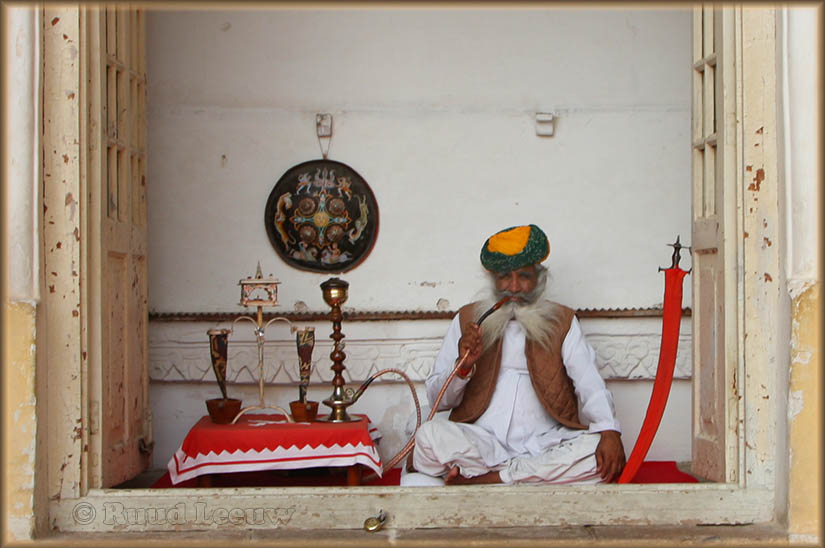 |
 The women is obviously eyeing me closely and not for my good looks, I imagine. The child wasn't playing music at that moment, but if she had seen me taking a photo (I was shooting from the hip) she would have demanded money, I am sure. It isn't that I don't begrudge them a few rupees, but I don't want to promote child labour... Confusing! |
|
| Battle scars of canon ball hits, by the attacking armies of Jaipur, can still be seen on the second gate. |
 |
 |
 |

Ancient door |
|
By 11:00 we were in the car again, heading for Jaisalmer!  |
UDAIPUR TO JODHPUR BACK NEXT JAISALMER |
Helpful links: Indiaonline.nl (Dutch) www.suncityjodhpur.com/jodhpur www.india-tourism.com www.bharatonline.com Lonely Planet Wikipedia |
|


